Tabletop Time Machine
PENTE GRAMMAI (FIVE LINES)

TEMPLE Five Lines board on the eastern pediment of the temple of Leto, Delos (Photo: Ulrich Schädler)
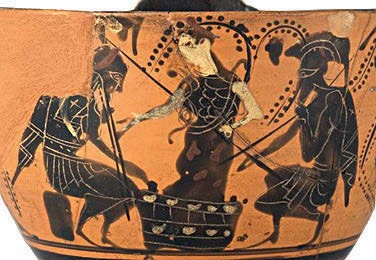
VASE Ajax and Achilles playing Five Lines, vase painting, early 5th century BCE (Musées Royaux d’Art et d’Histoire, Brussels, inv.no. R2512)
It’s always tempting to claim one game as ‘the ancestor of’ another, just because it’s similar and came first. But reconstructing ancient games is a tricky activity in default of written rules of play, and there is a danger of reading back into them features of their supposed descendants.
The ancient Greek game of Pente Grammai, or Five Lines, is a case in point. It’s often mentioned and partially described in literature of the so-called ‘Dark Ages’, but rarely from first-hand experience. Even by the 2nd century CE encyclopaedist Julius Pollux considered it ‘an obscure piece of antiquity’, and the 12th-century Eustathios’ description is based at second-hand on one by the poet Alcaeus (c. 625-580 BCE, supposed lover of Sappho).