On the beat
News and events from around the world this month
During the pandemic, some luthiers have begun making online courses to record their techniques and share their knowledge. Is it a viable alternative to one-to-one teaching?
By Peter Somerford
Read all the breaking news in the string world online www.thestrad.com
Adaptive learning
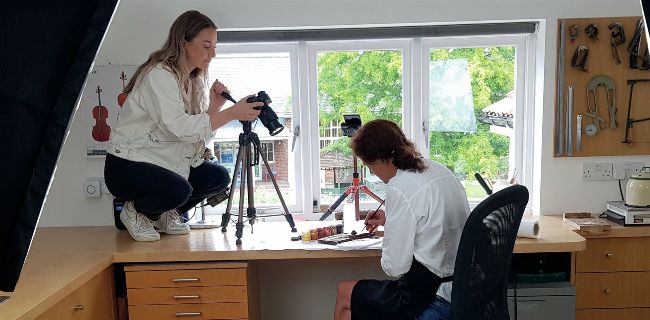
Iris Carr being filmed for her online course by Evie Troy
LEO CARR
In this era of unprecedented knowledge-sharing among instrument makers, YouTube is one of the most accessible forums for students of the craft. Some luthiers are particularly active on the platform, demonstrating their methods and sharing repair tips. A number of makers, such as Peter Westerlund from Sweden, have created long series of videos documenting their complete process of making an instrument (bit.ly/2UTfbkV). While YouTube is free, makers have also monetised video content, using membership platforms such as Patreon, or by creating standalone, paid-for online courses. Two such courses launched in early 2021: a 12-hour professional-level neck graft course by UK-based restorer Iris Carr, on the platform Teachable (bit.ly/3hkqr0W); and a 37-hour violin making course by Cremona-based maker Lucas Fabro, available from guitar maker Robert O’Brien’s website (bit.ly/3qy7Jas).
Carr, who has taught restoration and retouching workshops in France, Japan, the US and Poland, decided to create an online course when she realised the pandemic would take away her regular teaching opportunities. For Westerlund, who began his YouTube series in April 2020, the timing of the pandemic was incidental; he had reached his 400th instrument and decided he wanted to document his highly individual method, which involves knocking the plates or scratching them with a fingernail and listening to the resultant tones to guide the arching and graduation. He says: ‘I thought, “Why not explain exactly how I do it?” I used to be a maths teacher, so there was also something inside me about wanting to teach other people.’ Fabro had started making YouTube videos mainly for fun, and was not immediately persuaded when O’Brien approached him about doing an online course. ‘I always thought you can’t teach how to make a violin online,’ he says. ‘But when I looked again at my first violin, I became so convinced that I could have done something better if I’d had a very good video, with clear explanations, something I could go back and rewatch.’