Reviews
RECORDINGS
HOMAGE TO BACH BACH
Solo Violin Sonatas: in G minor BWV1001, A minor BWV1003, and C major BWV1005
Brodsky Quartet
CHANDOS CHAN20162
Seamless cohesion in commendable Bach arrangements
Brodsky Quartet violist Paul Cassidy here extends his adept arranging skills to his ‘bible’, using techniques such as registral change, textural contrast and varied instrumentation of some repeated sections to reveal these sonatas in fresh guise. Chandos’s church recordings are very reverberant and their close miking picks up the ensemble’s sniffing and adversely affects its perceived dynamic range (notably in BWV1003’s final Allegro); nevertheless, the Brodskys take pains to whisper much of BWV1003’s Andante and demonstrate commendable cohesion, balance and blend throughout.
They pass phrases and thematic fragments seamlessly from one to the other, particularly in BWV1001’s Presto, and their accounts of the fugues are models of structural reflection, in which voice leading is clearly delineated. Pizzicato adds lightness to some episodes and underpins the opening of BWV1003’s Andante and BWV1005’s Largo, most pedal points are dramatically ramped up, and violist and cellist combine into a veritable rhythm section in BWV1005’s finale.
Tempos are generally apt, but the opening adagios of BWV1001 and 1003 feel too measured, despite Gina McCormack’s occasional quasi-improvisatory forays, and the Presto of BWV1001 seems too steady. However, despite the new perspective offered, these accounts will always be more of a supplement than a staple of listeners’ Bach diet.
ROBIN STOWELL
AMERICAN QUINTETS
BEACH Piano Quintet op.67 PRICE Piano Quintet in A minor BARBER Dover Beach Kaleidoscope Chamber Collective, Matthew Rose (bass) CHANDOS CHAN 20224
Outstanding collection of lesser-known chamber works from talented ensemble
This outstanding debut album by Wigmore Hall associate ensemble the Kaleidoscope Chamber Collective brings together an exceptional array of talent, including violinists Elena Urioste (alongside regular playing partner, pianist Tom Poster) and Melissa White, violist Rosalind Ventris and cellist Laura van der Heijden. They immediately arrest the attention by starting Amy Beach’s op.67 Piano Quintet senza vibrato and, as the main Allegro moderato gets under way, pace the mounting sense of emotional intensity to perfection. In the wrong hands, Beach’s unmistakably Brahmsian creative trajectory can create a mild sense of stylistic déjà vu, but played like this, sensitively nurtured with a sonic profile like crushed velvet (captured in alluringly opulent sound by Jonathan Cooper and Patrick Friend), she emerges as a ravishingly inspired master in her own right.
Rediscovered in an Illinois attic in 2009 and first published in 2017, Florence Price’s A minor Piano Quintet is inscribed ‘1952’, although on stylistic grounds it is more likely to date from the mid-1930s. Brahms is once again the principal stylistic springboard, yet listeners are propelled along by Price’s deeply personal rhythmic and melodic inflections, derived from spirituals, hymns and plantation songs (late Dvořák is brought to mind on several occasions), and unexpected moments of expressive rhetoric, such as the opening movement’s violin recitativos.
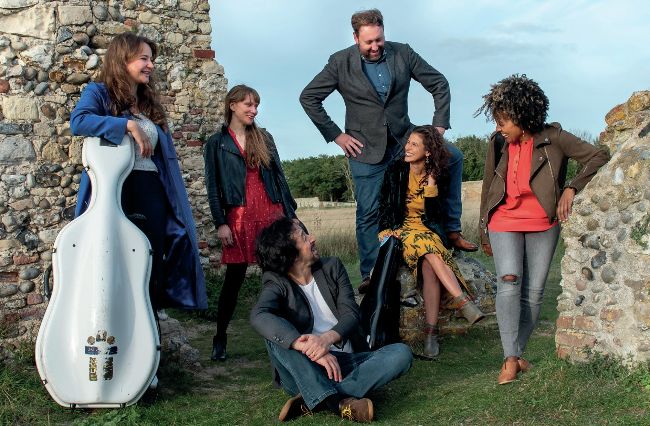
Kaleidoscope Chamber Collective and singer Matthew Rose
Barber’s Dover Beach is given another winning performance, Matthew Rose’s radiantly mellow tones blending with Kaleidoscope’s exquisitely inflected soundscape to captivating effect.
JULIAN HAYLOCK
To browse through more than a decade of The Strad ’s recording reviews, visit www.thestrad.com/reviews
LAWRENCE SUMULONG
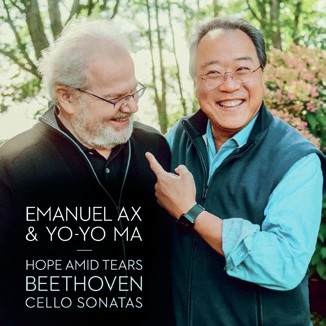
HOPE AMID TEARS BEETHOVEN Cello Sonatas Yo-Yo Ma (cello) Emanuel Ax (piano) SONY 19439883732
A sense of quiet magnificence radiates from two master musicians
The title may take on particular overtones in the current pandemic but it stems from Beethoven’s apparent inscription, ‘Amid tears and sorrow’, on the dedication copy of his op.69 Cello Sonata, a work whose positive outlook belied the composer’s inner turmoil at a time when his deafness was complete and Napoleon was invading Austria.
There’s a similar duality in Ma’s and Ax’s performances, which exude natural (often magical) warmth and eloquence, shunning surface effects while being underpinned by a super-attentiveness to details of tonal colour, phrasing, touch and transparency. There’s a quiet magnificence in the room, and it stems from the vast individual experience of these two musicians, continuing a collaboration of over 40 years driven by hunger and curiosity. Ax’s own particular long-standing association with Beethoven shines through at every turn and the recording quality is excellent.