INHERITING OTHERS’ PUPILS
A FRESH START
Taking on other people’s ex-pupils can be a tricky business – especially when they come with ingrained unhealthy habits. Focusing on upper strings, Alun Thomas outlines what may need to be addressed to make progress
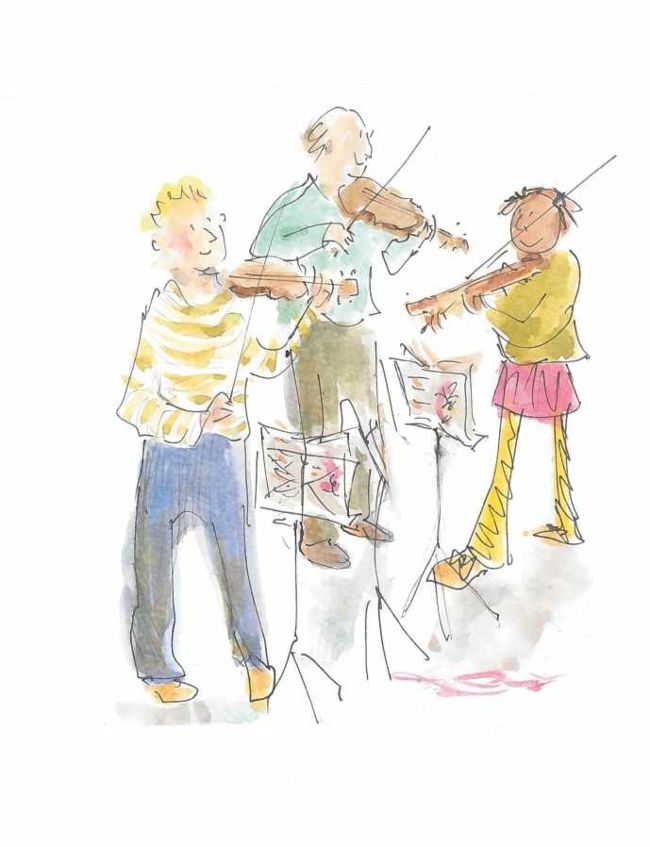
ILLUSTRATIONS BY ADELAIDE IZAT
Among the many regular, occasionally intense conversations I have with my colleagues and friends about playing and teaching, one stands out in some relief. Stated axiomatically, it goes something like this: ‘Inherit a student and you inherit their teachers’ habits!’
Over the last few years I’ve pondered, indirectly, the validity of this statement: if there were some truth in the claim, it follows that on the one hand it would be a good idea to maximise the positive aspects for the betterment of the student; on the other hand, however, minimising any potentially negative effects would be the primary task for the inheriting teacher. But as with any other axiom and especially in the world of string teaching, there are plenty of caveats and contradictions, and occasionally there is some special pleading.
As an experienced violinist and tutor, including a specialist psychophysical teacher (Alexander Technique) for more than two decades, I had the initial idea for this article following extended periods of inheriting small teaching practices – one at a well-appointed private school and another at a state music centre in Wales.
There are so many facets to a positive teacher–pupil transition. For younger children, warmth, fun and kindness take precedence, whereas for a serious slightly older pupil (teenagers and college students form the group that I mainly consider) – desirable though these softer elements must always be – the progressive route must include, at times, their capacity to accept the unvarnished truth on the road to resilience.
USING THE BACK
I well remember a student who told me that his (esteemed) previous teacher had begun to encourage him to ‘use his back’ when he played. I was intrigued to see that his own conception of the directive yielded the exact opposite! He’d contorted himself in such a way that he had cut off the connection between his arms and his back, rounding his back in such a way as to lose overall height, thus restricting easy and free breathing.
It is too often the case that any direct muscular response to a teaching directive simply results in a rearrangement of habits – one habit may be lost and several others enter by the back door. It takes a gentle but firm hand to guide a new student to do less and take on a process-oriented mindset – that is, using thought rather than leaping straight into doing something muscularly.