Reviews
RECORDINGS
SOUL OF BRAZIL
ASSAD Glitch JOBIM Four Songs (arr.Assad) VILLA-LOBOS String Quartet no.6; Cair de tarde Clarice Assad (singer, piano)
Delgani Quartet
AVIE AV2620
A finely conceived album with a standout Villa-Lobos quartet
The title listing gives away Assad’s versatility as a composer-performer but it doesn’t follow that her writing talents extend beyond her own genres. In fact Glitch sounds like a real quartet, and not a promising idea in a foreign context. The premise is simple: glissandos and ostinato patterns embody a faulty piece of code, which (like in DNA, not computers) can become the next stage of evolutionary development. Better still, the piece ends at an instinctively right time while leaving the ear wanting more.
The European battle over tonal and non-tonal harmony was not one that Brazilian composers ever had to fight, and it leaves no mark on Assad’s piece, or the Sixth Quartet of Villa-Lobos. It’s rhythm that most characteristically makes them sound Brazilian, however, and the Sixth begins with a jerkily syncopated idea, hard to ‘read’ in traditional terms, which previous recordings have either flattened out or played almost as a mistake. The Delgani absorbs it within a performance that utterly beguiles, with the cross-rhythms, samba-bass and moonshine moods of the finale especially convincing.
Only the excessively close and dry engineering discourages a full recommendation, and Assad is recorded in a different acoustic, pop-style, for a quartet of songs by Antônio Carlos Jobim. Her arrangements for quartet, though, show that European distinctions between commercial and art musics are, again, irrelevant: Jobim’s harmony shares a bittersweet complexity with his companions on this richly rewarding album.
PETER QUANTRILL
BEETHOVEN Cello Sonatas nos.1–5; Variations: on Mozart’s ‘Ein Mädchen oder Weibchen’ op.66, on Handel’s ‘See, the conqu’ring hero comes’ WoO45, on Mozart’s ‘Bei Männern welche Liebe fühlen’ WoO46
Gary Hoffman (cello)
David Selig (piano)
LA DOLCE VOLTA LDV111/2 (2 CDS)
A new Beethoven cycle offers a fulfilling listen
Beethoven’s works for cello and piano span his creative life and illustrate how he gradually transformed the keyboard-dominated ‘accompanied sonata’ of his inheritance into a musical conversation between equal partners. Although the pianist is the more ‘talkative’ in the two op.5 sonatas, David Selig notably displaying his dexterity in their spirited rondo finales, cellist Gary Hoffman tellingly contributes some significant thematic exposition and dialogue. Equality is essentially achieved in the Third Sonata op.69, the serene, lyrical outer movements of which give Hoffman ample opportunity to showcase the mellifluous sonorities of his 1662 Nicolò Amati. The same work’s expansive Scherzo also features some crisply articulated repartee, which is intensified in the more contrapuntal op.102 sonatas, particularly in the development of the Allegro vivace of no.1 and the striking Allegro fugato in no.2’s finale. These players truly plumb the expressive depths of op.102 no.2’s mournful Adagio and offer compelling musical insights in their readings of the lyrical Adagio cantabile of op.69’s finale and the pensive slow introduction and melancholy, dramatic Allegro of op.5 no.2’s opening movement.
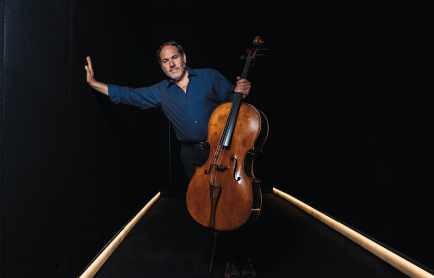
Bold Beethoven from Gary Hoffman
WILLIAM BEAUCARDET
Hoffman and Selig dispatch the three variation sets with due aplomb, responding appropriately to the music’s contrasting moods. Selig is again the dominant partner, displaying impressive dexterity in the figural variations of op.66 and WoO45, but Hoffman occasionally grabs the limelight, notably in the rapid-fire triplets of op.66’s seventh variation and the second half of Variation 10. Both engage in closer dialogue in WoO46, particularly in its fifth variation’s playful instrumental interchanges.
The recording is well-balanced but occasionally too present to accommodate comfortably the piano’s higher registers.
ROBIN STOWELL
BERNSTEIN Music for String Quartet COPLAND Elegies Lucia Lin, Natalie Rose Kress (violins) Danny Kim (viola) Ronald Feldman (cello)
NAVONA RECORDS NV6557
A major Bernstein discovery in a compelling performance
A world-premiere recording of a recently rediscovered Bernstein string quartet will naturally provoke a lot of attention – and in this wonderfully propulsive account of the composer’s Music for String Quartet it more than fulfils expectation.