GB
  
You are currently viewing the United Kingdom version of the site.
Would you like to switch to your local site?
14 MIN READ TIME

HISTORICALLY INFORMED PERFORMANCE

BAROQUE REVOLUTION

Historically informed performance requires no secret code, argues Baroque violin professor Walter S. Reiter. The information is out there for the taking, and modern music colleges need to get ahead of the game
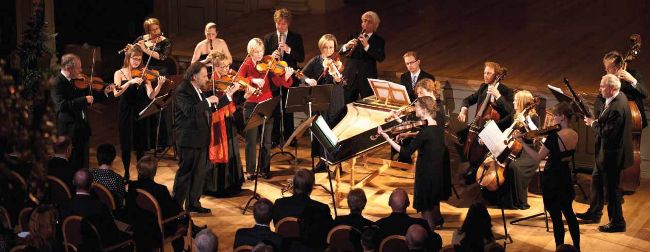
Walter Reiter leads Oslo-based period ensemble Barokkanerne in 2012

Afrequent response to my confessing that I play the Baroque violin goes something like this: ‘Oh, so you play without vibrato?’ Another reaction is supposedly more positive: ‘How wonderful… you mean Vivaldi and… er…’ But neither phrase does any justice to the intensive research involved in the interpretation of a sonata by, for example, Pandolfi Mealli (‘Who?’) based on information gleaned from historical sources with regard to the stylus fantasticus, mid-17thcentury instrumental technique, rhetoric, authentic organology, appropriate pitch used (in Innsbruck) in the 1660s, affect, the quirks of musica ficta and tempo relationships (if any). Neither do these responses recognise the meticulous accumulation of information based on the study of music by the myriad composers who preceded Bach, the one Baroque composer most of us do play – even though he himself copied out their works,and without their influence he would not have been Bach as we know – or think we know, or do not know – him.

The names of many of the Baroque composers I most revere do not even appear in the old 1920s edition of Grove’s Dictionary slumbering in my local library, for their music lay on dusty shelves in church and court archives or in state libraries until the Baroque revivalists lovingly gathered it up and set it free to move and inspire us once more. How much astonishing variety there is: a century and a half of rich repertoire, sacred and profane, spiritual and uplifting, from the Venice of Monteverdi (right) to the Vienna of Mozart via the Versailles of Mondonville (‘Who?’), with styles shifting from decade to decade and from city to city – not to mention ‘world Baroque’, such as the music of the Chiquitos, who composed Baroque-style Masses deep in the Bolivian jungle until the late 1800s, without even realising that Beethoven had come and gone!

It is now time to recognise what the historically informed performance (HIP) revolution has achieved over the past half-century, for it has radically altered the way we hear and perform music from the Baroque and Classical periods, and indeed from the Romantic era, shining new light even into the nooks and crannies of the early 20th century. For us violinists, it has brought to light a cornucopia of captivating music and with it the instruments whose sounds transport us back into a distant world. For some musicians, accepting the very concept of HIP is still the musical equivalent of converting to another religion; yet HIP today is no longer the unique domain of specialists, for soloists, conductors, chamber ensembles and symphony orchestras the world over are exploring music in this new–old way, both on original and on modern instruments.

Read the complete article and many more in this issue of The Strad
Purchase options below
If you own the issue, Login to read the full article now.
Single Digital Issue September 2021
 
£4.99 / issue
This issue and other back issues are not included in a new subscription. Subscriptions include the latest regular issue and new issues released during your subscription. The Strad
Annual Digital Subscription £54.99 billed annually
Save
23%
£4.58 / issue

This article is from...


View Issues
The Strad
September 2021
VIEW IN STORE

Other Articles in this Issue


In This Issue
Editorís letter
ANGELA LYONS S ince Japanese violinist and pedagogue
Contributors
PABLO ALFARO (Trade Secrets, page 82), originally from
SOUNDPOST
NEW DISCOVERIES
LETTER of the MONTH I am astonished.
ONLINE OR OFF?
Last year my pupil numbers took a drastic
COMPETING INTERESTS
I’ve often heard from disgruntled students, after they’ve
SUSTAINABLE SOUNDS
I second the request of Brendon Mezzetti (Soundpost,
ONLINE COMMENT
Arseniy Strokovskiy’s complaint that the Ysaÿe competition jury
FRONT
Cloud coverage
Online-only competitions have become ubiquitous in the past year, and competitors have had to adjust quickly to this new way of assessment. Where does the future lie?
NEWS IN BRIEF
Philharmonie de Paris announces lutherie competition bit.ly/2Ter3xc
OBITUARIES
ALLAN STEPHENSON South African cellist, conductor and composer
Force of nature
PREMIERE of the MONTH
COMPETITIONS
1 Eva Rabchevska RABCHEVSKA PHOTO MARTÍNEZ DE ALBORNOZ.
Signs of recovery
The June auctions in the UK capital brought together a number of interesting bows and instruments, with signs that the market is on the up and up, writes Kevin MacDonald
Gut reaction
VIOLIN STRINGS
IN SAFE HANDS
Cremonese case manufacturer Musafia has designed a fourth
ALL IN ONE
The Revoluthier ‘Basic’ violin workstation from Hubert Lutherie
Life lessons
The Latvian violinist recalls growing up in a musical family, and stresses the importance of hard work
MAKE ’EM LAUGH
Humour can be a useful tool when teaching – especially online, argues Naomi Yandell
FEATURES
Every child can
Since Japanese violinist Shinichi Suzuki founded his method of bowed string tuition in 1945, it has been adopted and embraced by countries around the world. Samara Ginsberg talks to teachers and students, past and present, about their experiences of Suzuki teaching and its enduring popularity
‘Every tone has a living soul’ – Shinichi Suzuki
Suzuki’s study of violin tone was his lifetime’s work. Here violinist and teacher Helen Brunner shares personal reminiscences of working with him
The art… of deception?
Making a new instrument look old is a painstaking craft that requires skill, patience and imagination. But why do luthiers spend their time creating an unreal effect? Peter Somerford speaks to both advocates and critics of the process
CLASSICAL CRUSADER
French cellist Christian-Pierre La Marca’s Wonderful World recording project highlights the environmental challenges facing humanity – and musicians really can make a difference, he tells Tom Stewart
INTELLIGENT DESIGN
The science of violin acoustics has encompassed 3D scanning, CNC technology and good old-fashioned tap tones – so why not AI software? Sebastian Gonzalez presents the results of a project that could help predict an instrument’s tone qualities even before it’s made
THE UNSUNG HERO
The Soviet cellist Daniil Shafran was a unique performer with a highly individual technique and sense of interpretation. He deserves to be recognised as one of the 20th century’s great instrumentalists, writes Oskar Falta
SIZE DOES MATTER
Viola players everywhere know the difficulty in finding the perfect instrument – but how many realise the differences that size, shape and weight can make to playability and tone? William Castle gives a step-by-step guide to finding the one that’s right for you
REGULARS
ANATOLY LEMAN
IN FOCUS A close look at the work
Varnish crackle effects
An easy approach to varnish crackle and faux crackle techniques that could be applied to restoration and antiquing
MY SPACE
A peek into lutherie workshops around the world
Historically informed?
Are the gut strings used in HIP really true to those used by 18th- and 19th-century players? Kai Köpp examines the technical reasons why today’s strings might sound quite different from their predecessors
HAYDN CELLO CONCERTO IN D MAJOR
MASTERCLASS
Overcoming common misconceptions in Suzuki teaching
TECHNIQUE
Reviews
Your monthly critical round-up of performances, recordings and publications
THIS MONTH’S RECOMMENDED RECORDINGS
Our pick of the new releases
RECORDINGS
BACH Sonatas and Partitas for solo violin BWV1001–1006
BOOKS
Sight Reading Strings: A progressive method Naomi Yandell,
From the ARCHIVE
The Strad ’s regular correspondent ‘Lancastrian’ (Dr William Hardman) gives his impressions of Eugène Ysaÿe, then at the height of his powers
IN THE NEXT ISSUE
Janine Jansen The Dutch violinist talks about
MATT HAIMOVITZ
For the cellist, Ligeti’s Sonata for Solo Cello was the doorway into the complex world of modern and non-classical music – with a little help from the composer himself
Chat
X
Pocketmags Support