THE UNSUNG HERO
The Soviet cellist Daniil Shafran was a unique performer with a highly individual technique and sense of interpretation. He deserves to be recognised as one of the 20th century’s great instrumentalists, writes Oskar Falta
DANIIL SHAFRAN
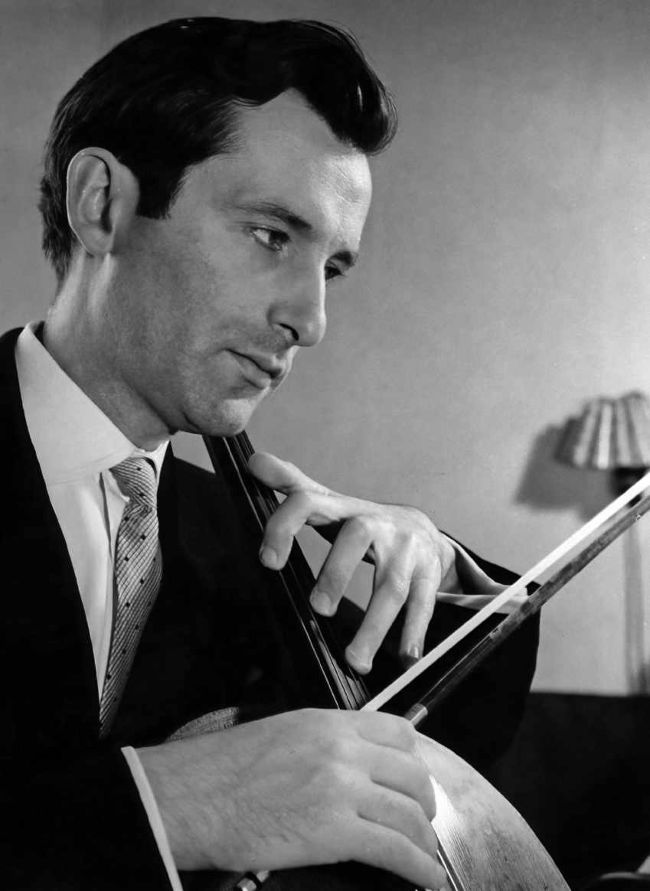
TULLY POTTER COLLECTION
The Russian cellist Daniil Shafran, one of the greatest musicians of the Soviet era, was born in 1923 to Russian-Jewish parents in Petrograd (soon after renamed Leningrad, today’s St Petersburg). At the age of eight, he started cello lessons with his father, Boris, who became principal cellist of the Leningrad Philharmonic Orchestra (LPO) under Yevgeny Mravinsky. Two years later, Shafran was accepted into the class of professor Alexander Shtrimer (1888–1961) at the Leningrad Conservatoire.
Shafran made his debut in 1935 with the LPO under Albert Coates and two years later received the first prize at the USSR All-Union Competition for violinists and cellists held in Moscow. This victory led to Shafran’s first recording engagement the same year: Tchaikovsky’s Rococo Variations with the LPO conducted by Alexander Gauk. During the Second World War, as the front was approaching Leningrad, several of its cultural institutions were evacuated to safer regions of the USSR: the conservatoire to Tashkent (Uzbekistan), and the Philharmonic Orchestra – along with Shafran’s parents – to Novosibirsk.
Shafran first stayed behind and became a volunteer in the People’s Militia. As the infamous Siege of Leningrad intensified, he left the city and joined his parents in Novosibirsk. There, he appeared several times as soloist with the exiled LPO under the direction of Mravinsky and Kurt Sanderling, and gave concerts in hospitals and for soldiers of the Red Army.
In 1943, Shafran became a soloist with the Moscow State Philharmonic and moved to the capital. His first tour abroad in 1946 took him to Romania, where he gave a cello and piano recital with George Enescu. In the same year he recorded Shostakovich’s Cello Sonata with the composer at the piano (see box, page 63). Shafran continued to take part in competitions, most notably in Budapest (1949 competition of the World Festival of Youth and Students) and Prague (1950 Hanuš Wihan International Cello Competition), where on both occasions he shared the first prize with Mstislav Rostropovich.
Shafran began to give concerts beyond the Iron Curtain in 1960, when he performed at Carnegie Hall with the State Orchestra of the USSR. He returned to the US twice more: in 1964, giving recitals in New York and San Francisco, and in 1977, performing the complete Beethoven sonatas with Anton Ginsburg at Lisner Auditorium in Washington DC. Shafran appeared in Britain for the first time in 1964, in a recital at Wigmore Hall and as soloist at the Royal Festival Hall, both in London. Meeting Carlo Maria Giulini led to Shafran’s collaboration with the conductor and the Vienna Symphony in a televised concert of the Dvořák Cello Concerto in 1973.