RALL-E
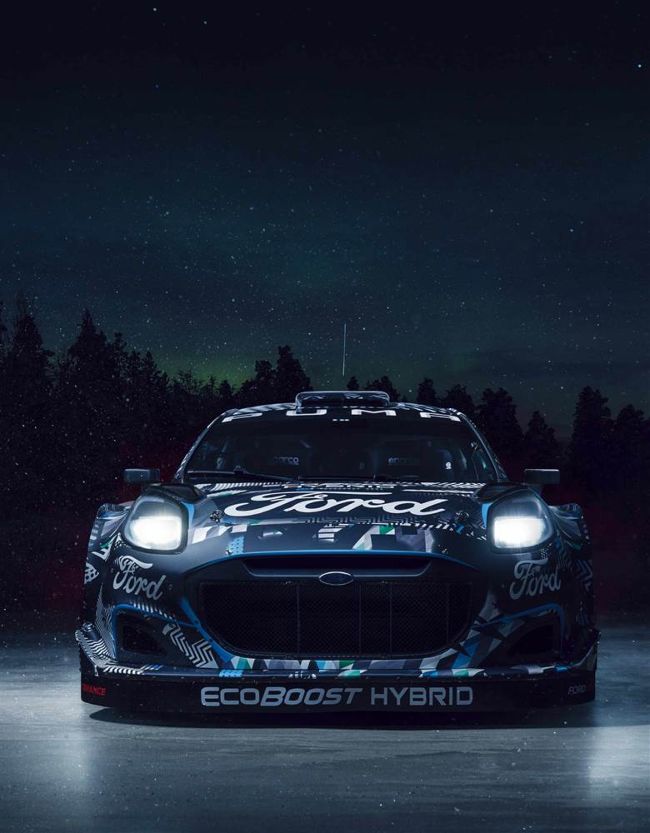
The future of of f-road racing is battery powered and madder than ever... as Ford’s 2022 WRC Puma and Audi’s Dakar contender shall now demonstrate
WORDS STEPHEN DOBIE & GREG POTTS
HOTOGRAPHY JOHN WYCHERLEY
“ON THE START LINE, DRIVERS WILL BE ALLOWED FULL POWER FOR THEIR FIRST ACCELERATION”
“
T This is an entirely different thing. It’ll take a switched-on crew to get something out of that.” Sage words from a man who knows his mud-flapped onions. David Lindsay has spent the last two decades shaking down M-Sport’s, and thus Ford’s, World Rally Championship competitors. From the Focus WRC made famous by McRae to the outgoing Fiesta WRC that took title honours with Ogier – and everything in between – he’s driven it. If anyone can deliver a succinct vox pop on how the new hybrid powered Ford Puma WRC feels, David’s yer man.
The 2022 season brings a number of big regulation changes, and the growth from Fiesta to Puma visualises them nicely. As well as being safer, the cars are bigger, with another 107mm in their FIA-regulated wheelbase and an additional 70kg of timber. Or rather batteries. This is the first appearance of electrification in top-flight rallying, and it’s going to cause a stir.
The Puma’s mechanical core isn’t far off the Fiesta it replaces. A 1.6-litre four-cylinder engine continues to drive all four wheels through a five-speed sequential gearbox, with peak output of around 400bhp.
What’s most obviously new is the addition of another 134bhp in hybrid boost, vastly raising the power-to-weight ratio... sometimes. And it’s the same for all cars; the battery pack arrives sealed up from Compact Dynamics and is placed in a location chosen by the FIA to both maximise safety and create some parity in the weight distribution of Ford, Hyundai and Toyota’s Rally1 class contenders.
But neither the Puma nor its i20 and Yaris rivals will be 500-odd horsepower cars for long. On the start line, drivers will be allowed full power for their first acceleration, lasting around three seconds. Which is basically the car’s 0–62mph time. Then it’s back down to petrol power only until the driver earns what’s called a “valid regen”. Basically, they have to brake hard enough and long enough to satisfy a set of criteria and unlock a 30 per cent boost which might already be sitting there untapped.
It’s hard to imagine some of the most committed rally drivers of yore –a certain Scotsman, whose pictures decorate the halls of M-Sport’s Lake District base, comes to mind – being altogether cool with deliberately hard braking where it’s not needed, merely for a brisk electric boost onto the next straight. Mind, braking hard into a corner before exiting with a whole heap of extra power may make for some extraordinarily slapstick action.