MILES DAVIS
Moments of magic from turbulent times.
The Complete Live At The Plugged Nickel 1965 (reissue, 1995) UNIVERSAL
By Jon Dale
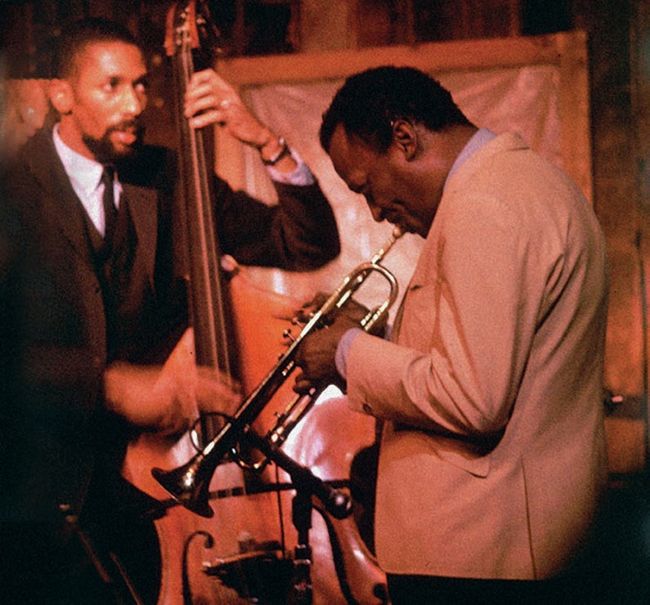
Covers blown: Davis pulls apart jazz standards in the mid-’60s
SONY MUSIC ARCHIVES
9/10
ONE of the signal releases from Miles Davis’s second ‘great quintet’, the two-night stand recorded for The Complete Live At The Plugged Nickel 1965 has long been held in high esteem by both Davis obsessives and jazz scholars. It wasn’t simply a case of conquering personal trials and tribulations that made the music here seem so relevant and biting, though surely that has something to do with its significance. The quintet had been off the road for seven months while Davis suffered through firstly hip surgery, then further surgery for a broken leg, and a subsequent implanted plastic hip joint.
By 1965, the second great quartet of Davis, Herbie Hancock, Tony Williams, Ron Carter and Wayne Shorter had already recorded one of the strongest albums in Davis’s ’60s catalogue, 1963’s ESP, and several of the players were busy with side-gigs, or launching solo careers, most notably Hancock, whose Maiden Voyage was released in 1965. Davis had brought Shorter over to the quintet from Art Blakey’s Jazz Messengers, after letting go of George Coleman, and a brief tryout for Sam Rivers, who was deemed too avant-garde. (Indeed, Davis’s relationship with the jazz ‘avant-garde’ and free jazz, which was building a head of steam in the mid-’60s, was combative and tendentious.)
Decades of subsequent aesthetic development across jazz can sometimes leave the music performed on Plugged Nickel feeling a little understated; similarly, given the general hosannas that have accumulated around its extensive, documentarian 450 minutes, its occasional passages of longueurs have you wondering, is it really that good? It’s understandable, particularly given the way Plugged Nickel is often presented to listeners as a line drawn, quietly, in the sand. After all, free jazz got much wilder and fiercer, far more immediately and mappably interactive than this.
But if Miles Davis and his various 1950s and 1960s groups pioneered ‘quiet intensity’ within bop and post-bop contexts, Plugged Nickel comes across differently. There’s little ‘quiet’ here, in the mold of Kind Of Blue. Instead, lip-bitten feverishness spreads everywhere, almost unchecked, like a virus. There’s something distinctly uneasy, brittle and febrile about much of the music here that makes it stand out, not just from contemporaneous Davis albums, but from the corpus of 1960s jazz – free and otherwise. Put simply, nobody else was doing quite what this music did.
It was the result, in part, of a silent mutiny in the quintet. If 1965 was an annus horribilis for Davis personally, it was also a year where the quintet was beginning to feel as though it was stagnating. In a later interview, pianist Herbie Hancock reflected, “Even within our very creative and loose approach to the music, everybody did things according to certain kinds of expectations… It became so easy to do that it was almost boring.” They’d come to this collective conclusion after the first batch of quintet shows after their half-year break, where they’d played in Washington DC, New York, Detroit and Philadelphia.