OMD
RADIO WAVES
Two “No Hopers from the Wirral”, ORCHESTRAL MANOEUVRES IN THE DARK became modernist hit makers until Dazzle Ships – awildly innovative album inspired by musique concrète, Cold War paranoia and Eastern Bloc broadcasts – almost sank them. Forty years on, however, the legacy of Dazzle Ships has steadily grown. “It hurt at the time,” they confess to Graeme Thomson. “Because we put our heart and soul into it.”
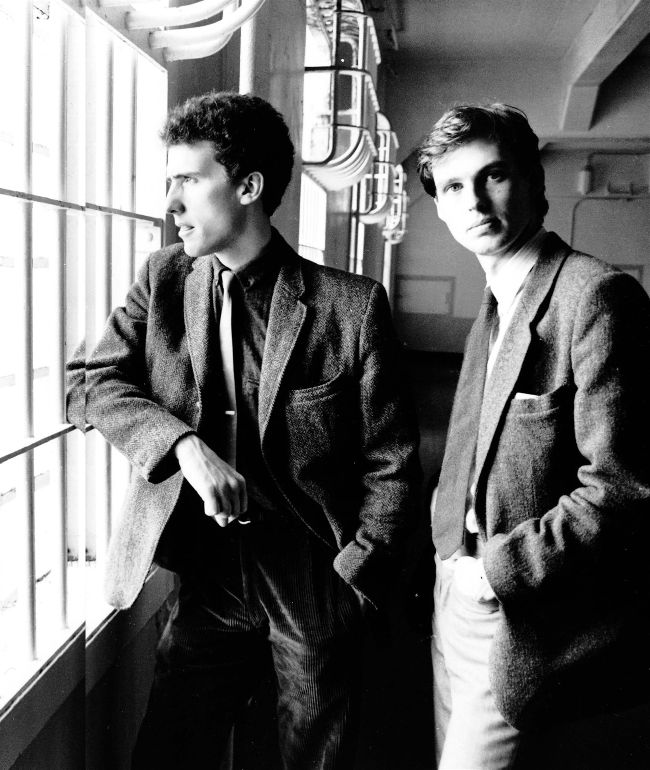
“We thought we had the Midastouch”: OMD’s AndyMcCluskeyand Paul Humphreys, 1981
Photo by CHRIS WALTER
EVERY band celebrates success in its own way. For Orchestral Manoeuvres In The Dark, following the colossal triumph of their 1981 album, Architecture & Morality, the good times involved settling into The Gramophone Suite, their down-at-heel “sonic laboratory” in central Liverpool, and firing up the shortwave radio to eavesdrop on Eastern Europe. “We used to have a few drinks and start scanning the shortwave radio,” recalls Paul Humphreys. “We’d put one of the tape machines into record and just see what happened randomly, then make notes of things, mark the times, wind back and cut them out. That was all part of our mad experimental blast.”
This electronic tapestry of call signs, radio waves, news items, tones and pulses became the bedrock of OMD’s glorious puzzle, Dazzle Ships. Inspired by musique concrète, the Vorticist art movement, Cold War paranoia, Eastern Bloc broadcasts, Kraftwerk at their most experimental and the brave new world of sampling, the band’s fourth album was many things: bold, beautiful, hubristic, confounding, ahead of its time – and quite shockingly unsuccessful. Architecture & Morality had sold three million copies and spawned three Top 10 singles. In the space of just under 35 minutes, with Dazzle Ships, OMD lost 90 per cent of their audience, and almost lost their heads. CHRISWALTER/WIREIMAGE
“It was a shock to us how massive Architecture & Morality was,” says Humphreys. “We were very young, and we lucked out because we did whatever the hell we felt like doing and every album got more and more successful. When we got to Dazzle Ships we thought, ‘Let’s just do a musique concrète album and write songs about the Cold War and get our shortwave radio out and get call signs from Eastern Europe and people will love it.’”
People didn’t love it – at least not at the time. Savaged by critics, the album sold poorly and quickly vanished. Forty years later, it has come to be regarded as an overlooked masterpiece. “It was much, much more interesting than it was given credit for at the beginning,” says Peter Saville, who inspired the album title and designed the sleeve. “Latterly, the opinion about it has been fundamentally revised; people now see it as a progressive and innovative album.”
Among those who have revised their opinion of the record, according to OMD’s Andy McCluskey, is his long-term working partner. “In the last few years, Paul seems to have readopted this album!” says McCluskey. “[At the time], I definitely got the feeling that Paul looked at me and went, ‘This is your fault!’ Dazzle Ships really was very much me, walking us down to the end of the plank and falling off, commercially. Now people look at it and go, ‘Oh, wow, what an amazing collection of concepts and ideas.’”