ARCHIVE
GEORGE HARRISON
All Things Must Pass: 50th Anniversary Super Deluxe
A fitting update to George’s magnum opus.
By Tom Pinnock
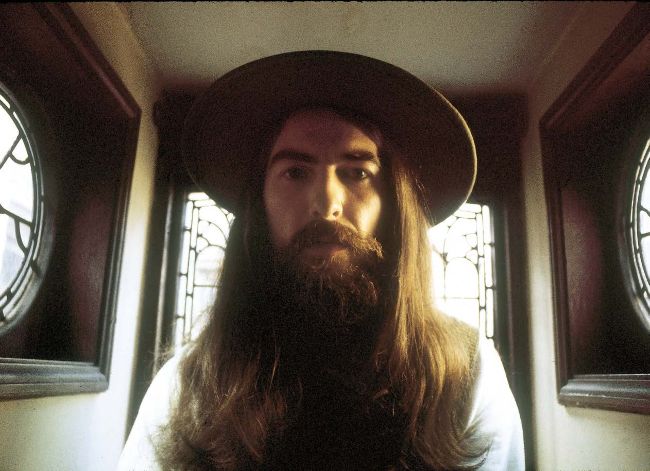
George at Friar Park in 1970
BARRY FEINSTEIN
Edition CAPITOL/UME
10/10
FOR a while now, 51 years maybe, there’s been talk of de-Spectorising All Things Must Pass, of wiping away the reverb like grime from a golden murti. Phil didn’t make it easy, though: rather than adding effects during mixing, the layers of echo that cloud this motherlode of songs and jams are often baked onto the tapes themselves.
This 50th-anniversary edition, therefore, is not the clear and crisp version of All Things Must Pass that’s hovered in some people’s imaginations for decades like some audiophile Holy Grail, as sparse and dry as 1973’s Living In The Material World. On this new mix by Paul Hicks, the fog is very much there, but a little daylight (good at arriving at the right time, you may recall) has been let in. The breadth and ambition of All Things Must Pass remain astounding in better definition: for a sense of scale, George’s contributions to the ‘White Album’ total 13 minutes, while All Things Must Pass is itself 13 minutes longer than the entirety of The Beatles.
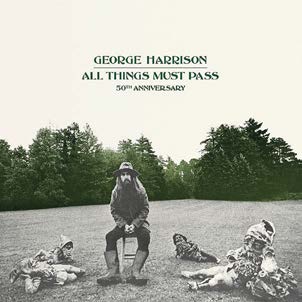
The most striking difference here is Harrison’s voice, set forward, intimate and relatively dry, so that quivers or inflections in his singing that might have been subsumed in the mush are unearthed. Instrumental parts are also clearer: the acoustic guitar picking, timpani rolls and low, buzzing synth on “Isn’t It A Pity”, the subtleties in the drums on “I’d Have You Anytime”, every curlicue of Pete Drake’s pedal steel, even the maelstrom of free-jazz horns and guitars at the end of the immense “Let It Down”. Harrison’s masterful slide guitar parts (he had only taken up the technique the year before) are even more striking in this new setting.
If we don’t get an entirely new All Things Must Pass though, what we do get are a number of hypothetical alternative versions. For an ATMP where Harrison’s passion for The Band and John Wesley Harding-era Dylan takes precedence, check out day one’s acoustic guitar, drums and bass demos of “Behind That Locked Door”, “Dehra Dun”, “I Live For You”, a slower, funkier “My Sweet Lord” or the Bob co-write “Nowhere To Go”, or day two’s plaintive “Run Of The Mill” or a dirgier “Art Of Dying”. As an album, it would have been no starker than Plastic Ono Band, released two weeks later.
However, if Harrison had only had ears for the soulful gospel and R&B he loved around that time, then electric band demos of “What Is Life”, “Awaiting On You All” and “Going Down To Golders Green” give a good idea of what might have arisen. For some other avenues ripe for exploration, see the Fabs-y garage of the “I Dig Love” demo, a solo “Hear Me Lord” that’s today reminiscent of something baked and slow from Neil Young’s Zuma, or the three-minute demo of “Isn’t It A Pity”, which shines a light on how the song could have sounded if The Beatles hadn’t rejected it for Revolver.
The two discs of proper early takes demonstrate how the final recordings came together through live performances, with Harrison refusing to dictate what the musicians played after suffering such treatment at the hands of top songwriting duo Lennon-McCartney.
SLEEVE NOTES
5CD+BLU-RAY SUPER DELUXE
CD 1 – Main Album CD
2 – Main Album CD
3 – Day 1 Demos 26th May 1970
1 All Things Must Pass (Take 1) †
2 Behind That Locked Door (Take 2)
3 I Live For You (Take 1)
4 Apple Scruffs (Take 1)
5 What Is Life (Take 3)
6 Awaiting On You All (Take 1) †
7 Isn’t ItA Pity (Take 2)
8 I’d Have You Anytime (Take 1)
9 I Dig Love (Take 1)
10 Going Down To Golders Green (Take 1)
11 Dehra Dun (Take 2)
12 Om Hare Om (Gopala Krishna) (Take 1)
13 Ballad Of Sir Frankie Crisp (Let It Roll) (Take 2)
14 My Sweet Lord (Take 1) †
15 Sour Milk Sea (Take 1) † Previously Released
CD 4 – Day 2 Demos 27th May 1970
1 Run Of The Mill (Take 1) †
2 Art Of Dying (Take 1)
3 Everybody/Nobody (Take 1)
4 Wah-Wah (Take 1)
5 Window Window (Take 1)
6 Beautiful Girl (Take 1)
7 Beware Of Darkness (Take 1)
8 Let It Down (Take 1)
9 Tell Me What Has Happened To You (Take 1)
10 Hear Me Lord (Take 1)
11 Nowhere To Go (Take 1)
12 Cosmic Empire (Take 1)
13 Mother Divine (Take 1)
14 I Don’t Want To Do It (Take 1)
15 If Not For You (Take 1) † Previously Released
CD 5 – Session Outtakes & Jams
1 Isn’t ItA Pity (Take 14)
2 Wah-Wah (Take 1)
3 I’d Have You Anytime (Take 5)
4 Art Of Dying (Take 1)
5 Isn’t ItA Pity (Take 27)
6 If Not For You (Take 2)
7 Wedding Bells (Are
Breaking Up That Old Gang Of Mine) (Take 1)
8 What Is Life (Take 1)
9 Beware Of Darkness (Take 8)
10 Hear Me Lord (Take 5)
11 Let It Down (Take 1)
12 Run Of The Mill (Take 36)
13 Down To the River (Rocking ChairJam) (Take 1)
14 Get Back (Take 1)
15 Almost 12 Bar Honky Tonk (Take 1)
16 It’s Johnny’s Birthday (Take 1)
17 Woman Don’t You Cry For Me (Take 5)
Blu-ray – Main Album in surround, Atmos, hi-res stereo
The first take of “Wah Wah” is already a whirlwind of sound, pretty much ready, with just vocals to be improved; take 27 of the second version of “Isn’t It A Pity” is almost done. Some tracks are presented in more embryonic states: take five of “I’d Have You Anytime”, with its overbearing drums and Spectorish grand piano, shows little sign of its later spectral grace, while take 36 of “Run Of The Mill” opens with harmonised lead guitars which are a little too bombastic for such a thoughtful piece. Other highlights include take five of “Hear Me Lord”, nine minutes that culminate in a hypnotic, spiralling outro, and a funkier take on “What Is Life”, with Harrison’s voice raspily throwing forward to 1974’s Dark Horse.
Curiously, like Lennon during the Plastic Ono Band sessions, he also has a jam on “Get Back”.
The genius of the completed All Things Must Pass is that Harrison managed to combine all those possible results into a cohesive whole that sounds like little else. Excavating all the possible permutations is an illuminating exercise, but in the end you’ll most likely find that you prefer the original record – tapestries do have a habit of ceasing to exist when they’re unpicked.
This is a world where the thundering tumult of “Wah Wah” happily sits alongside the Greenwich Village folk of “Apple Scruffs” or the soul groove of “I Dig Love”, and a lot of that success is down to the echoey fug laid by Spector around most of these songs, like the accessory that completes a whole outfit. It’s the holy haze of voices, the distant clang of massed instruments, that elevates and unifies this album’s spiritual hymns of longing and its earthly tales of desire and pain.
Harrison may be the best-loved Beatle in 2021; his grace, humour and spiritual searching feel very relevant to now. Musically, too, he seems to make sense in our anxious times: the most played Beatles song on streaming services, by a country mile, is “Here Comes The Sun”. This new mix updates his finest work for today, in greater detail than ever before, while still managing to retain the atmosphere that binds these 106 minutes together. It seems a mind can blow, at least some of, those clouds away.
Extras: 9/10. Available in a variety of formats including an Uber Deluxe Crate, which includes George & gnome figurines, various books, prayer beads, a wooden bookmark sourced from a felled Friar Park oak and lots more.
Q&A
Dhani Harrison: “It must have been a heavy record for him”
What did you want to achieve when you started on this box? We’re not going to do this again [at this scale], so we wanted everyone to feel represented. You can’t choose which fans’ version you want to do, you have to do ita ll. It was quitea jigsaw puzzle.
Were you originally hoping to de- Spectorise the album? Paul [Hicks] and I have tried to lean away from that. The original record was brilliant. Some of the decisions Spector made were perfect, and some were not the best for the track. My dad was always trying to pull back in the reverb. We’ve stayed true to everything as best we could, but now you can hear all these things that were buried in the mix.
What did your dad think of the original album? It must have been a heavy record for him, but he was proud of it; when we did it again in 2000, he was very happy to be working on it all. It’s an intense record and a very intense period in his life – his mum passed away, he’d left his band, he’d moved. He dived full force into the Friar Park vibe, and that’s why Friar Park and All Things Must Pass are so connected. He created what he set out to do, musically, and spiritually, and physically in the garden at Friar Park. So, big success! This LP coming out now, given what everyone in the world has been through… it seems appropriate that it’s coming back to us at this time.
TOM PINNOCK
AtoZ
This month…
P42 AZTEC CAMERA
P43 GENTLE GIANT
P43 CARAVAN
P44 CHRISTINE PERFECT
P46 JACKIE LEVEN
P46 PRINCE
P47 CHARLES MINGUS
P47 LESLIE WINER
MOSE ALLISON
The Complete Atlantic/ Elektra Albums 1962–1983
STRAWBERRY/CHERRY RED
8/10
Twenty years in the career of an eccentric jazz icon
DAVID M. BENETT/DAVE BENETT/GETTY IMAGES FOR V&A
Mose Allison had the best deadpan in jazz. His piano playing was spry, often mordant, but his voice suffused every note with a low-key beatnik irony and turned every lyric into a missive that only the hippest of listeners could decipher. A Mississippi farmboy who served in the army and studied literature at Louisiana State University, he’d lived several lives and released nearly 10 albums before he signed with Atlantic, where he endeared himself to jazz bohos and rockers alike. As a songwriter, he brought a sharp wit to counterculture rebellion (“Young Man Blues”, famously covered by The Who) and anti-war dissent (“Everybody’s Cryin’ Mercy”, a hit for Bonnie Raitt). This generous set collects a dozen albums on half a dozen CDs, chronicling Allison’s heyday as well as his fallow period in the early ’80s, portraying him as an extremely idiosyncratic solo performer and a highly mischievous ensemble player.
Extras: 7/10. New, lengthy liner notes.
STEPHEN DEUSNER
KAREN BLACK
Dreaming Of You 1971–1976
ANTHOLOGY
7/10
Uncovered reels from Golden Globe-winning actor/songwriter
Chicagoan Karen Black was best known for her work as an actor – across a fourdecade-plus career, she appeared in such films as Easy Rider, The Great Gatsby and Five Easy Pieces. She oscillated between genres, as comfortable in the arthouse as she was on the horror screen. Less known, though, is her music, even as she wrote songs for some of the films she appeared in. Dreaming Of You was compiled by Black’s friend Cass McCombs, on whose albums she guested, and it reveals a smart, generous songwriter with a gentle melodic sensibility. Given the pared-back acoustic guitar and voice setting, you’d be forgiven for placing this with other once-lost folk singers like Sibylle Baier and Elyse Weinberg, and while there are connections, Black has her own thing going on: the songs skirt profundity through everyday observational flair; the voice arresting, the phrasing stagy but assured.
Extras: None.
JON
DALE
BRICOLAGE
Bricolage CREEPING BENT
7/10
The sound of wan Scotland
In retrospect, it may have been unfortunate that Bricolage, in their brief existence (2005– 2009), became known as “Franz Ferdinand’s favourite band”. The Glasgow-based four-piece shared influences, notably an appreciation of the repurposed funk rhythms that were popular among acts on the Postcard label (Bricolage were more Orange Juice, while Franz mainlined Josef K). The band’s early promise was short-circuited when singer Wallace Meek left as the single “The Waltzers” was released. It’s a breezy record with a Northern Soul drumbeat and a riff like a fire engine stuck in traffic, but the setback prompted Memphis Industries to decide against releasing the LP. From this distance it’s clear that Bricolage’s influences were broader than they seemed. There are echoes of Roxy Music (or at least Suede) and producer Stephen Lironi (ex-Altered Images) keeps it brisk, adding tasting notes of candy floss to the bruised Orange Juice of “Turn U Over”.
Extras: None.
ALASTAIR
McKAY
TIM BUCKLEY
Bear’s Sonic Journals: Merry- Go-Round At The Carousel
OWSLEY STANLEY FOUNDATION
8/10
Recently unearthed live bliss from folk-rock pioneer
Drawn from a twonight stand, mid-June 1968, at the Carousel –a venue that’s better known as the Fillmore West – Merry-Go- Round has Buckley grabbing the reins of his music and not letting them go for its entire 80 minutes. There have been variable live Buckley sets circling throughout the years, but this one’s a valuable addition to his catalogue, partly for the elastic expressivity of the playing, partly for its uncovering of songs such as “Blues, Love” and “The Lonely Life”. The two versions of “Buzzin’ Fly” have Buckley diving deep, teasing out the nuances of his free-weaving melody; a gorgeous closing weave around “Strange Feeling” is alternately spacey and whip-smart, a drifting splendour. It’s a great set, but someone really needs to dig out those Starsailor band shows for some documentation of Buckley at his most astral.
Extras: 8/10
Typically excellent liner notes from rock scholar and researcher Pat Thomas.
JON
DALE
CARAVAN
Who Do You Think We Are?
MADFISH
8/10
Limited, 37-disc box of entire back catalogue, live tracks and rarities
You could probably buy an actual caravan for little more than this £275 boxset but fans of these Canterbury Scene alumni might still feel that this sumptuous set is worth it. The blend of quirky, pastoral prog and inventive instrumental jams that characterised early albums still charms, and even if the schoolboy humour of albums like Cunning Stunts and For Girls Who Grow Plump In The Night has worn thin, the music mostly endures. Highlights on this set are freewheeling, previously unreleased versions of live staples such as “The Love In Your Eye” and “For Richard” along with alternative takes on classic material such as the 1996 acoustic reading of 1971’s “In The Land Of Grey And Pink” (on the disc All Over You), which replaces the sublime piano and guitar solos with mandolin drenched in cheesy but strangely onbrand psychedelic back-masking.
Extras: 8/10
Bonus tracks included on studio albums, 11 unreleased live CDs, DVD of a European Blu-ray 5.1 surround sound remix of In The Land Of Grey And Pink, book, poster, fanzine, signed picture, map of Canterbury, band family tree... and more.
JOHNNY
SHARP
ERIC CLAPTON
Eric Clapton (reissue, 1970)
UMC/POLYDOR
7/10
Stepping out on a sturdy solo debut
Released 18 months after Cream signed with Goodbye, off Clapton’s first album under his own name sees him accompanied by sundry members of Delaney & Bonnie & Friends (with whom he toured extensively during his “gap” year-anda-half) and the core players who’d go on to form Derek & The Dominos. Its contents hint at the beginnings of the laidback “Slowhand” persona he’d cultivate further, yet while the guitarplaying is sublimely fluid throughout, a question mark tends to hang over the thin vocals, suggesting an initial lack of self-confidence in his singing chops.
Nonetheless, there are earthy blues tones to the Delaney Bramlett and Leon Russell co-write “Lonesome And A Long Way From Home”, muscular bass and backing vocals from Stephen Stills on “Let It Rain”, and the first fruits of a collaborative friendship on a cover of JJ Cale’s 1966 single “After Midnight”.
Extras: 7/10. Three discs of alternate mixes; period recordings with King Curtis and Delaney & Bonnie.
TERRY
STAUNTON
GENTLE GIANT
Free Hand (reissue, 1975)
ALUCARD MUSIC/SOULFOOD
7/10
Unorthodox proggers’ marginally less difficult seventh album reissued
Even at prog’s commercial peak, Gentle Giant remained something of a cult concern, which they addressed by signing to Chrysalis and turning out their most accessible set to date in the shape of Free Hand. It achieved a career-high Billboard chart position of 50 in the US, but unlike the GG albums that followed, that wasn’t achieved by unpicking the knotty tangle of jazz chord progressions, baroque harmonies and angular, Crimson-ish avant-rock that built their reputation. Its strengths are newly honed here by prog’s remixer-inchief Steven Wilson, who crisps up the four-voice fugues of “On Reflection”, and adds punch to songs such as “Just The Same” and the title track, whose hopscotching syncopated grooves fully justify their wilful complication.
Extras: None.
JOHNNY
SHARP
GOAT
Headsoup ROCKET
7/10
History-refreshing blast from the Swedish shapeshifters
When they appeared in 2012 with their costumes, masks and fuzz-heavy, acid-rock raga “Goatman”, this collective was seized on with cultish enthusiasm. Debut LP World Music was a satisfying stew of ritualised chanting, wild psych rock, Afrobeat and ’70s funk/blues rock that didn’t wholly define its makers; four years later, Requiem tipped the balance from wild wig-outs to globe-trotting wonderment. Headsoup compiles 13 non-album tracks, opening with “The Sun The Moon”, the hectic, Can-ish flipside of “Goatman”, then moving through the joyous, flute-driven “Union Of Mind And Soul” (a different version from the one on Requiem) to a radio edit of the hard-swinging “Let It Burn”. There are two new tracks, too: “Fill My Mouth” and “Queen Of The Underground”, respectivelya shuffle-funk jam and sleazy, Sabbath-toned epic.
Extras: None.
SHARON
O’CONNELL
GRATEFUL DEAD
Grateful Dead (Skull & Roses)
(reissue, 1971) RHINO
8/10
Dead freaks unite! 50th anniversary fora Grateful classic
Skull & Roses captures the Grateful Dead in transition. They’d lost Mickey Hart but hadn’t yet welcomed Keith Godchaux, so the live recordings that make up the album, from April ’71 shows at the Fillmore East, Hammerstein Ballroom and Winterland, have the group playing as a stripped-back quintet. There are moments of longueurs – parts of the improvisations don’t quite fall together, with “The Other One” oscillating from telepathic to sloppy in a manner of seconds – but they introduce a bunch of Dead standards here, and it’s worth it for the sublime, elemental depth-charge that is “Wharf Rat” alone.
Extras: 7/10. Ten live recordings from the Dead’s July 2 show at the Fillmore West in San Francisco, which features a limber run through “Cryptical Envelopment” to “The Other One”, and a wistful real-time cross-fade from “Not Fade Away” to “Going Down The Road Feeling Bad”.
JON
DALE
BRIAN MAY
Back To The Light (reissue, 1992) VIRGIN
6/10
Expanded reissue of May’s first post-Queen release
Released 10 months after the death of Freddie Mercury, May’s first proper solo album was culled from sessions recorded over the previous five years, with several songs also recorded by Queen, such as “Too Much Love Will Kill You”. Much of the album is reminiscent of Queen at their heaviest but sung by an earnest May rather than an unhinged Mercury: “I’m Scared” sounds like a punkier moment from News Of The World; “Love Token” is a histrionic, ballsout rocker; and the folksy “Let Your Heart Rule Your Head” recalls A Night At The Opera’s “39”. Best of all is the galloping, rabble-rousing prog-metal of “Resurrection”.
Extras: 7/10. Eleven extra tracks include three Hank Marvin-style instrumental versions of songs from the LP; versions of the single “Driven By You” (including one used on a Ford ad) and live versions of May’s band playing Queen tracks “Tie Your Mother Down” and “We Will Rock You”.
JOHN
LEWIS
CURTIS MAYFIELD
Curtis (reissue, 1970) RUN OUT GROOVE/RHINO
9/10
Twin-vinyl edition of 1970’s blackconsciousness classic
On the verge of leaving The Impressions, Curtis Mayfield embraced funk and psychedelic soul as America entered a new decade, though his central directive remained unchanged. The songs on solo debut Curtis took up where Civil Rights anthems “People Get Ready” and “We’reA Winner” left off. “(Don’t Worry) If There’s A Hell Below We’re All Gonna Go” is a gravely apocalyptic vision of racial unity, driven by wahwah and an immense fuzz bass; shifting between symphonic soul and a loose jam, “We The People Who Are Darker Than Blue” is no less powerful; ripples of strings conceal the inner-city rage of “The Other Side Of Town”. And the euphoric “Move On Up” (recently adopted by Joe Biden for his presidential campaign) is all the more striking in its extended form.
Extras: 7/10.Nine bonus tracks, including terrific demos of “Power To The People” and “Ghetto Child”. Note that this reissue is only being released in the US.
ROB
HUGHES
CHARLES MINGUS
Mingus At Carnegie Hall RHINO
8/10
Landmark 1974 concert hall date which veers into free-jazz territory
Mingus had overcome a decade of personal turmoil before he was offered the chance to present a rare celebration of jazz in New York’s most prestigious classical concert hall. Most of the tracks on this two-hour set are about 20 minutes long: they start as intricately arranged charts that become the basis for lengthy improvisations, changing tempo, rhythm and genre without losing sight of the melody or chord structure. Mingus never particularly liked free jazz, but his core sextet here – featuring Cecil Taylorish pianist Don Pullen, impudent baritone saxophonist Hamiet Bluiett and high-notehitting trumpeter Jon Faddis – often move in that direction, lurching from leisurely ballad-playing to tricksy hard bop to ecstatic freakouts. The two final tracks (previously released on a 1974 LP) are jam sessions based on Duke Ellington songs with additional guests – Roland Kirk stars in a rambunctious take on “Perdido” and a deconstruction of “C Jam Blues” that ends with a series of spectral, avant-garde drones.
Extras: None.
JOHN
LEWIS
PRINCE
Welcome 2 America LEGACY
7/10
A rare slice of socially conscious Purple funk, rescued from the vaults
“I love my brother Prince, but he’s no Curtis Mayfield!” said prominent left-wing academic Dr Cornel West in a 2010 TV interview. Prince, rather amused by this, responded with a Curtis Mayfield pastiche entitled “Born 2 Die”, featuring clipped rhythm guitar, a “Pusherman” falsetto, some “Superfly”-style string arrangements and street-level lyrics. It’s the high point of a rather good LP of socially conscious R&B, something somewhat uncharacteristic of Prince. “1,000 Light Years From Here” is a vision of a postracial US that continues the Mayfield theme; the title track is a slow-burning, “Sign O’ The Times”-style state-of-the-nation address that rails against corporate corruption and godlessness; the mid-tempo funk of “Running Game (Son Of A Slave Master)” is a meditation on the legacy of slavery. One wonders what kind of quality control Prince was operating in the years before his death: putting out boring prog-fusion albums but keeping gems like this in the vaults.
Extras: None.
JOHN
LEWIS
NINA SIMONE
Little Girl Blue (reissue, 1959) BMG
9/10
All in a day’s work for the future High Priestess of Soul
Charlie Mingus: improv master
GOSTA PETERSON TURN GALLERY
Having famously signed over her rights to a day’s recordings in exchange for $3,000, Nina Simone was unable to enjoy the fruits of her remarkable debut, even when, in 1987, Chanel licensed what’s now considered her signature tune, “My Baby Just Cares For Me”, thus introducing her to a new generation. Fortunately, everyone else can marvel at this newly remastered showcase for her expressive vocal and piano skills, from its opening reinvention of Duke Ellington’s “Mood Indigo” to her own closing, quietly swinging instrumental, “Central Park Blues”.A tender “I Loves You, Porgy” unexpectedly stormed the Top 20, and the poignancy of “He Needs Me” eclipsed Peggy Lee’s 1955 version. But the interpolation of a Bach tribute into the bridge of “Love Me Or Leave Me” and the title track’s use of “Good King Wenceslas” as an introduction highlighted Simone’s playful spirit too.
Extras: None.
WYNDHAM
WALLACE
PHILIP TABANE
The Indigenous Afro-Jazz Sounds of Philip Tabane and his Malombo Jazzman
(reissue, 1969) WE ARE BUSY BODIES
7/10
Vintage spiritual jazz from eccentric South African guitar-mangler
South Africa’s Philip Tabane was not much troubled by modesty. Though he played with jazz legends including Miles Davis and Herbie Hancock, he resisted the J-word and its colonial implications. “I don’t play like Miles,” he once said. “Miles plays like me.” His lean, choppy guitar style certainly strays far from jazz convention on this remastered ’69 collection, covering a broad spectrum from deconstructed African folk-pop melodies to bluesy minimalism. Leftfield jewels such as “Inhliziyo” and “Man Feeling” bristle with wonky tangents, strangulated twangs, spiky improvisations and sudden outbreaks of mellifluous beauty. There are even crackles of electrical static in “Babedi” and “Dithabeng”, flaws that almost feel like wilful glitch-punk distortion today. Crucial to Tabane’s evergreen avantprimitivism is longtime collaborator Gabriel “Mabi” Thobejane, whose inventive cow-hide drum volleys and dainty thumb-piano motifs provide sparing but potent counterpoint here.
Extras: None.
STEPHEN
DALTON
VARIOUS ARTISTS
Echo Wielkiej Płyty – Rare, Unreleased & Forgotten Electronic Music From Poland 1982-1987
THE VERY POLISH CUT-OUTS
7/10
Sentimental grooves from behind the Iron Curtain
Poland was a pioneer of electronic music. The Polish Radio Experimental Studio launched in Warsaw in 1957,a year before the BBC Radiophonic Workshop opened its doors. There, the likes of Krzysztof Penderecki would experiment. But for most musicians, access to the synths and hardware proved difficult during socialism. Only the state broadcasters had adequately equipped studios, so those who used them produced background and library fare – what became known as el-muzyka – in thrall to Jean-Michel Jarre and Tangerine Dream. This may explain the kitsch character and elaborate structure of a lot of Polish electronic music released in the ’80s on the Tonpress and Polton labels, and shows why even the obscure material on this compilation has a naïve, questing quality. That’s part of the charm of tracks by Andrzej Mikołajczak and Krzysztof Duda, while the Kraftwerkian funk of Grupa Jot and synthetic tears of Stefan Sendecki add a cosmopolitan touch.
Extras: None.
PIERS
MARTIN
VARIOUS ARTISTS
Habibi Funk 015: An Eclectic Selection Of Music From The Arab World, Part 2
HABIBI FUNK
9/10
What happened when funk, disco and reggae made their way east
Given the sometimes mercenary ways of crate-diggers bent on exposing realms of music little known to many Western listeners, German DJ and collector Jannis Stürtz has been remarkably respectful with his Habibi Funk releases of vintage recordings with scant circulation beyond homelands such as Libya and Lebanon. In his notes for the latest –a follow-up to the superb 2017 compilation – he notes the post-colonial complexities of endeavours like his own and laments the use of the word “funk” because of how it imposes a limited conception of music that had a wide variety of component parts and purposes. Really, what these amazing selections share is less about sounds and rhythms and more about the alchemy that occurs as outside influences – whether it’s the disco pulse of “Ya Aen Daly” by Najib Al Housh or the reggae lilt in Ibrahim Hesnawi’s “Tendme” – interact with regional tastes and styles as well as the idiosyncrasies of their creators. Then again, all such heady considerations melt away amid the pleasures to be found in Zohra’s shimmering “Badala Zamana” and “Free Blow (Dub Version)”, a Chic-worthy groover by Lebanese maverick Tony Benn Feghaly.
Extras: 8/10. A 12-page booklet accompanies 2LP black and colour vinyl editions.
JASON
ANDERSON
VARIOUS ARTISTS
Journeys In Modern Jazz: Britain (1965–1972)/Don Rendell – Space Walk/
Ken Wheeler & The John Dankworth Orchestra –
Windmill Tilter (The Story Of Don Quixote) DECCA
8/10, 8/10, 8/10
Three homegrown jazz albums given renewed life
Homegrown British jazz is undergoing something of a renaissance, which has angled the spotlight on an earlier generation of players. Decca’s new series of vinyl reissues kicks off with Journeys In Modern Jazz: Britain (1965– 1972), a double disc survey capturing seven years in which the UK scene responded – and in places expanded on – movements in the Stateside sound. Its four sides find a suite of combos putting their own stamp on the post-bop era, lining up cooly funky Rhodes jams (the Barbados-born trumpeter Harry Beckett’s “Third Road”), frenetic piano acrobatics (Collin Bates Trio’s “Brew”) and sashaying, funky jazz-rock (Michael Gibbs’ “Some Echoes, Some Shadows”). The series continues with a couple of LPs. Saxophonist Don Rendell had been a face for a couple of decades when he cut 1972’s Space Walk, but it hits just the right mix of playfulness and experience. Saxophone and flute take turns to effervescently solo above a bed of drums and vibraphone; it’s sometimes formal, often free, often a joy. Almost as good is Windmill Tilter (The Story Of Don Quixote), a 1969 album by Canadian trumpeter Ken Wheeler, backed by The John Dankworth Orchestra. Wheeler had one foot in London’s nascent free improv scene but his debut as a bandleader instead pursues a dynamic big-band style with flurrying guitar from a young John McLaughlin, shortly before he moved to New York to play on Miles Davis’sIn A Silent Way.
Extras: None.
LOUIS
PATTISON
LESLIE WINER
When I Hit You – You’ll Feel It
8/10
Career-spanning anthology of enigmatic New York artist
Adopted as a baby, Leslie Winer became a model in ’80s New York famed for her androgynous look, befriending the likes of Burroughs and Basquiat, before focusing on music. On Witch, Winer’s largely ignored 1993 Virgin debut, her provocative lyrics, delivered in a lackadaisical Tom Waits drawl, and love of heavy rhythm and dub framed her as a trip-hop pioneer. Since then, across a number of self-released albums and projects, she’s never really changed her tune, while artists – from Vincent Gallo and the late Jon Hassell to recent collaborations with Jay Glass Dubs (included here) and Maxwell Sterling – relish her unique, unpredictable quality. This is a fine introduction to her wild world.
Extras: 7/10. 24-page booklet with extensive liner notes.
PIERS
MARTIN
COMING NEXT MONTH...
W e’ll be taking a look at new records from Low, Sarah Davachi, The Felice Brothers, José González, The Stranglers, Laura Stevenson and Matthew E White, plus many more. In the increasingly busy world of archival releases, there’s a menacing Van Der Graaf Generator box, some very fine Bryan Ferry reissues, a cool John Coltrane comp and more.
EMAIL: TOM.PINNOCK@UNCUT.CO.UK