GOING OFF HALF CHARGED
On a long journey in an electric car, is it actually quicker to make shorter, more frequent charging stops and never go above 50% of the battery’s capacity? Neil Winn finds out
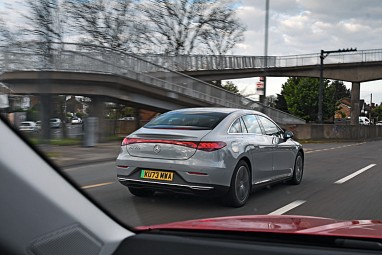
We used a pair of virtually identical Mercedes-Benz EQEs for this test
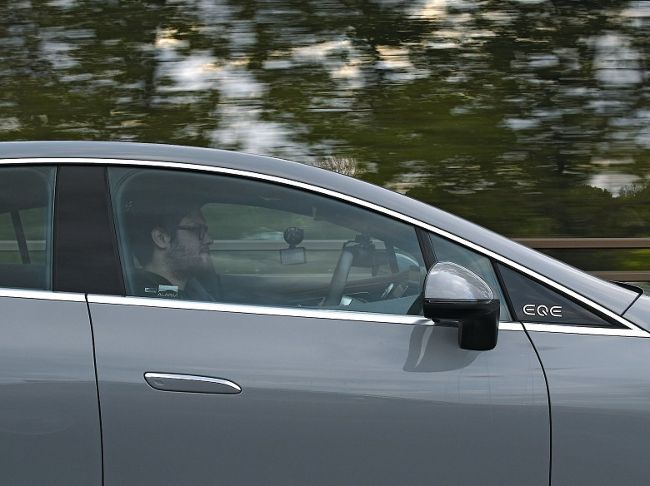
Neil was faced with stopping five times in 550 miles
A couple of years ago, What Car? set an unofficial world record for the most countries visited in 24 hours in an electric vehicle (EV), starting in the Netherlands and arriving in Serbia 14 countries (and many cans of Red Bull) later. It’s an accomplishment we’re very proud of, and one that we were convinced would be hard to top, until we heard about the exploits of an American chap called Wayne Gerdes.
You see, in the same year we set our record, Gerdes broke an official Guinness World Record for crossing the United States with the least amount of time spent charging, being plugged in for less than two and a half hours en route from Los Angeles to New York. Before him, the total charging time required to cover that 2834-mile journey was well over seven hours.
What was Gerdes’ secret, you ask? Well, when he paused to recharge, he never allowed his car’s battery to exceed 50% of its capacity, resulting in a staggering 18 stops along the way. While this ‘little and often’ approach might seem unconventional, it’s rooted in an understanding of an EV’s charging curve – the phenomenon where the charging rate varies during a single charging session.
Now, it’s worth pointing out that the maximum charge rate differs for each make and model of car, but it’s fair to say most batteries exhibit similar charging characteristics. Initially, an EV with a low battery level charges slowly, but then it accelerates up to its maximum rate and typically stays there until the battery is at around 50%, at which point the charging speed tapers off again.
To illustrate, consider pouring a pint of Guinness. You can really go for it at the start, but as the glass gets fuller, the pour gradually slows down. By the end, the last few millilitres trickle in. Topping up a battery is very similar, because the electrons coming in have to work harder to find space.