ASK Space
Our experts answer your questions
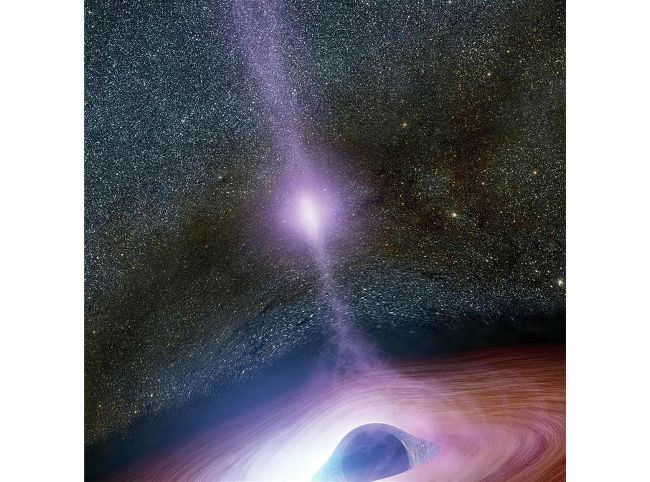
Black holes can fire out excess energy in bright beams called quasars
© NASA/JPL-Caltech
ASTROPHYSICS
How do black holes grow in mass?
Once born, black holes can grow by gobbling up gas, other stars or even other black holes. Black holes, particularly supermassive black holes sitting at the centres of galaxies, are often surrounded by gas. They can feed on this gas through an accretion disc –a pancake-like structure of gas that gradually spirals into the black hole. Some massive black holes take their time during this meal, but others go into a feeding frenzy. The rapid, messy eaters in active galactic nuclei try to double their mass over a timescale of around 100 million years, burping out excess energy in powerful jets that are observed as quasars.
Black holes can also pull material from stars that get too close. The black hole’s gravity raises t ides on a nearby star – like the tides in Earth’s o ceans, but potentially much stronger. If the t ides become too strong, gas from the star flows onto the black hole. This can happen gradually as a stellar companion to a black hole in a binary system evolves and expands in radius, giving rise to black hole X-ray binaries as gas is heated to X-ray-emitting temperatures when it spirals in towards the black hole. Or the entire star can be shredded in one spectacular flare, known as a tidal disruption event. Finally, two black holes can come together and merge, forming a single black hole whose mass is almost equal to the sum of the masses of the original black holes. A small fraction of the mass – around five per cent for equal-mass mergers – is lost in gravitational waves, ripples in space-time predicted by Einstein over a century ago and first detected by the Laser Interferometer Gravitational-wave Observatory (LIGO) in 2015.