Earth’s second moon
DOES EARTH HAVE A SECOND MOON?
MYSTERIES OF THE UNIVERSE
THERE’S AN ASTEROID TRACKING OUR PLANET’S ORBIT AROUND THE SUN, AND ASTRONOMERS HAVE BEEN SURPRISED BY ITS COMPOSITION
Reported by David Crookes
© Alamy; Getty
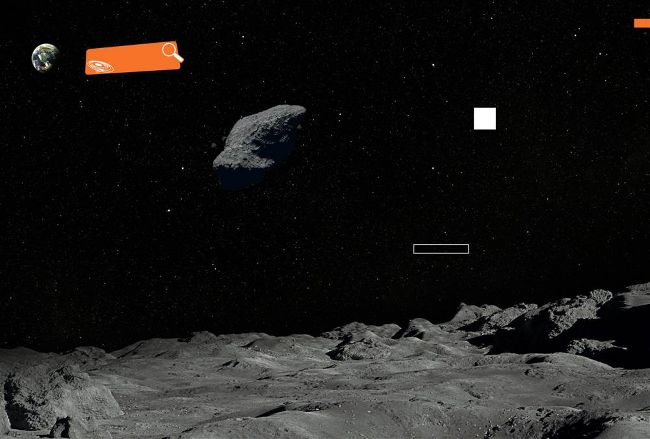
We all know that Earth only has one moon, and if you want proof of that, you just need to peer at the night sky. Can you see another? Astronomers are sticking to their guns by saying the Moon is Earth’s only natural satellite. Case closed… or so you’d think. In 2016, however, astronomers using the asteroid-hunting Pan-STARRS telescope in Hawaii discovered a rock orbiting the Sun while also repeatedly looping around Earth. Celestial objects such as these are called quasi-satellites, and while four others have been identified since 2004, this one was the closest and most stable ever seen.
What makes it particularly interesting is its potential origin, although a recent breakthrough has gone a long way towards clearing up the five-year mystery over what this object could be. The smart money is now on it actually being a fragment of our Moon. In that sense you could say it’s Earth’s second moon – as some have indeed dubbed it – though it’s not quite on that level, if truth be told. Still, it’s no less intriguing, and astronomers are keen to discover more.
MYSTERIES OF THE UNIVERSE
KAMO’OALEWA BY NUMBERS
9
million
The closest Kamo‘oalewa gets to Earth, in miles
25 million The farthest Kamo‘oalewa gets from Earth, in miles
365.9
Orbital period, in days
2016
Year it was discovered
45 to 58
metres The estimated size of Kamo‘oalewa
30
Kamo‘oalewa’s rotational period, in minutes
Nine
Number of asteroids found to have lunar origins
4
million
times fainter than the faintest star visible with the naked eye
500 to
100,000
Years ago it may have broken off the Moon
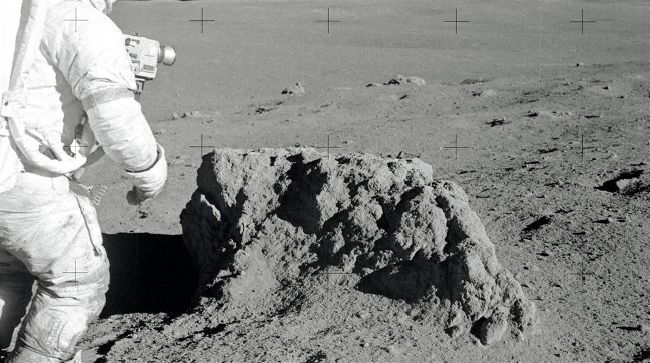
Rock samples collected from the Moon during the Apollo 14 mission compared almost perfectly to the data gathered about Kamo‘oalewa
One of the people leading studies into the object, which is being called Kamo‘oalewa –a Hawaiian name that roughly means ‘oscillating celestial fragment’ – is University of Arizona planetary sciences graduate student Ben Sharkey. For the past five years he has dedicated much of his time and energy into finding out the origin of the celestial body, with interest piquing following the recent publication of his team’s academic paper in the scientific journal Communications Earth & Environment.