GB
  
You are currently viewing the United Kingdom version of the site.
Would you like to switch to your local site?
8 MIN READ TIME

ASK SPACE

Our experts answer your questions
Galactic mergers can give rise to new galaxies
© NASA

GALAXIES

Can galaxies die?

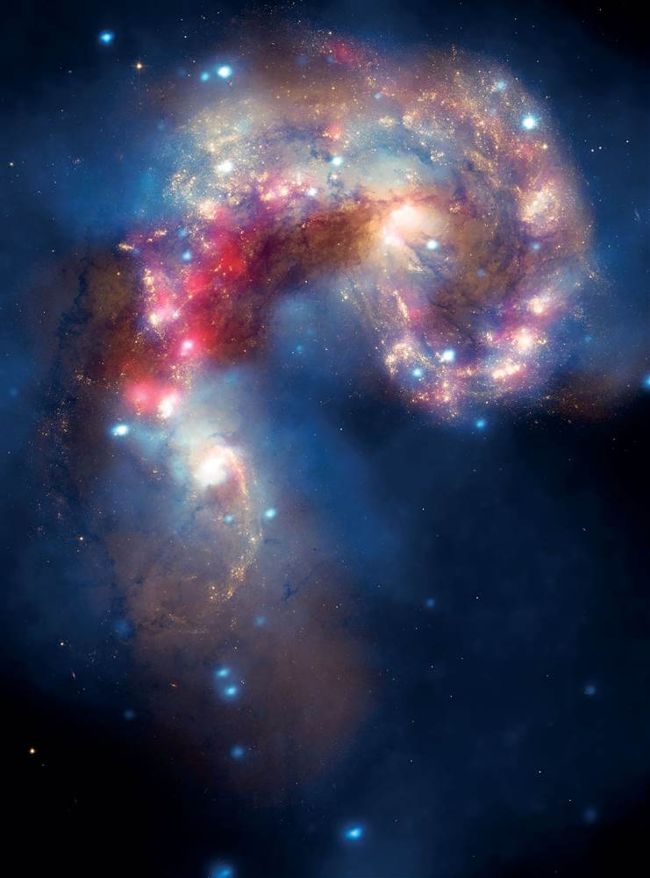
It very much depends on how you define a galaxy being alive! A common definition is that a galaxy is alive if it’s forming new stars, and by that definition, galaxies can and often do – die. Any galaxy we see that is very red in colour has mostly stopped forming stars – the blue stars that formed with the red ones die off the quickest, leaving the red ones behind.

There are many reasons a galaxy might stop forming stars – maybe it’s out of gas, needed to form new stars. Maybe the gas is there, but simply too hot to be able to cool and collapse down into a star. The end result is the same in both cases: no new stars. On the other hand, you could choose a more lenient definition: if it exists, it’s alive. To die would thus be to have the galaxy disappear entirely.

The closest we get is if the galaxy were to merge with another galaxy. It would then build a new galaxy with its companion, marking the end of its previous existence – though it hasn’t disappeared; it’s had all of its pieces folded, like clay, into a new form.

© Jennifer Manna

STARS

What’s the difference between a globular cluster and open cluster?

Globular clusters are much more massive, and they are usually much older. Open clusters have comparatively fewer stars and are comparatively young. Well, young in astronomical terms that is… There is pretty much nothing in between these two extremes, and the reason for this is as interesting as the question itself. Globular clusters are relics of an ancient time when the universe had more gas to fuel intense star formation. These conditions no longer exist (or are very rare) in the present universe. Forming a new globular cluster would be a feat, and thus new star clusters are comparatively smaller. There are no old open clusters simply because they have not survived billions of years of interactions with their host galaxies and environment; instead they have been split apart by gravitational interactions, and their stars now populate their host galaxies. Globular clusters survived their cosmic journey because they were massive enough to hold onto their stars for billions of years.

Unlock this article and much more with
You can enjoy:
Enjoy this edition in full
Instant access to 600+ titles
Thousands of back issues
No contract or commitment
Try for 99p
SUBSCRIBE NOW
30 day trial, then just £9.99 / month. Cancel anytime. New subscribers only.


Learn more
Pocketmags Plus
Pocketmags Plus

This article is from...


View Issues
All About Space
Issue 126
VIEW IN STORE

Other Articles in this Issue


Welcome
WELCOME
Issue 126
Launchpad
A room with a view
© ESO The appropriately named VISTA (Visible and
Interstellar wildfire
© ESO The Flame Nebula burns bright in
Ancient Martian riverbed
© NASA/JPL-Caltech/University of Arizona This image of the
JAMES WEBB SPACE TELESCOPE HAS ENOUGH FUEL FOR MORE THAN TEN YEARS OF SCIENCE
© CERN NASA’s newest flagship space observatory should
COMETS’ HEADS MAY BE GREEN, BUT NEVER THEIR TAILS
Comet ISON exhibiting a green glow on
‘COSMIC MONSTER’ STAR SPITS ENERGY WITH THE FORCE OF A BILLION SUNS
These dense objects emit powerful flares across
IMAGINARY NUMBERS COULD BE NEEDED TO DESCRIBE REALITY
IN COOPERATION WITH SPACE.COM Schrödinger wasn’t a
WHITE HOUSE DIRECTS NASA TO EXTEND INTERNATIONAL SPACE STATION OPERATIONS THROUGH 2030
NASA will continue to operate the ISS
ROCKET SCIENTISTS AREN’T ANY SMARTER THAN THE REST OF US, SCIENCE SAYS
The new study tested the minds of
Exoplanets
COMPLETE GUIDE TO EXOPLANETS
OUR KNOWLEDGE OF WORLDS BEYOND THE SOLAR SYSTEM HAS EXPLODED IN THE LAST THREE DECADES
Future Tech
MILLIONAIRE MOON TOURISM
Fancy a trip around the Moon? That’s what Space Adventures is offering to anyone able to afford the multimillion-dollar price tag
Interview
“WE WILL SEE IDEAS AND PRODUCTS WE CAN’T IMAGINE TODAY”
Axiom Space’s chief technology officer Matt Ondler on life after the International Space Station
ERUPTION SEEN ON ALIEN STAR FOR FIRST TIME
The outburst is about ten times more powerful than anything similar seen from our Sun
FOCUS ON
GOING BACK O THE MOON
THIS YEAR, NASA WILL TAKE THE FIRST STEP IN RETURNING ASTRONAUTS TO THE LUNAR SURFACE
BLACK HOLE IN MILKY WAY’S SATELLITE DEFIES EXPLANATION
Dwarf galaxy Leo I’s giant central area seems too big for such a small host
WHAT IS A LIGHT YEAR?
How we measure vast distances across the universe
GENERAL RELATIVITY PASSES ITS TOUGHEST TEST YET
The theory, which Albert Einstein published in 1915, remains undefeated
THE BIG BANG THEORY
IT’S OUR BEST MODEL OF HOW THE UNIVERSE WORKS, BUT WHERE DID IT COME FROM?
Star profile
STAR PROFILE RIGEL
Orion’s brightest star is a powerful blue supergiant
Instant Expert
WHAT IS DARK MATTER MADE OF?
The phenomena may have come from quantum bags that got squished together in the early universe
GEOCENTRIC MODEL
THE EARTH-CENTRED VIEW OF THE UNIVERSE
Focus On
NEW ROCKY EXOPLANET HAS A YEAR LESS THAN EIGHT HOURS LONG
The iron-rich planet orbits very close to its host and exhibits scorching temperatures
THE PLANET THAT SHOULDN’T EXIST
This two-star system with a mass six times that of our Sun emits extreme radiation, yet somehow a planet has still managed to form
NASA ORDERS MORE MEGABOOSTERS FOR MOON MISSIONS
The new contract will support Space Launch System (SLS) missions through Artemis 9
STARGAZER
WHAT’S IN THE SKY?
In this issue… 78 What’s in the sky?
THIS MONTH’S PLANETS
Observe before dawn and you’ll be able to catch dazzling Venus, Mercury and Mars in all their glory
COPERNICUS
Early 2022 allows us to pay our respects to ‘the Monarch of the Moon’
NAKED EYE & BINOCULAR TARGETS
February’s sky is a treasure trove of bright stars and glittering star clusters
THE KING’S JEWELS
One of the least famous constellations offers keen-eyed observers some fascinating and beautiful sights
THE NORTHERN HEMISPHERE
Plenty of objects are available to observers using the unaided eye, binoculars or a telescope
ASTROSHOTS OF THE MONTH
Get featured in All About Space by sending your astrophotography images to space@spaceanswers.com
CELESTRON UPCLOSE G2 10x50 BINOCULAR
Large objective lenses and 10x magnification help this affordable piece of kit appeal to anyone wanting to start stargazing
IN THE SHOPS
The latest books, apps, software, tech and accessories for space and astronomy fans alike
All About Space
HEROES OF THE SPACE
From CAPCOM to moonwalker, Duke was a pivotal figure in the Apollo program
Chat
X
Pocketmags Support