MYSTERIES OF THE UNIVERSE
THE PLANET THAT SHOULDN’T EXIST
This two-star system with a mass six times that of our Sun emits extreme radiation, yet somehow a planet has still managed to form
Reported by David Crookes
© Alamy
You would think that a planet which is 11 times as massive as Jupiter – itself the largest planet in the Solar System – would be very easy to spot. But that’s not always the case. If the method of discovery isn’t quite good enough, then it’s always going to be much more difficult to find something, even if it’s hiding in plain sight. This can lead to theories that turn out to be incorrect, and that’s what recently came to light when an exoplanet suddenly popped into view during a wideranging sky survey. Before this happened, some scientists firmly believed that planets couldn’t form around stars that were more than three times as big as the Sun. But that was primarily because no one had ever found any that did. They have now.
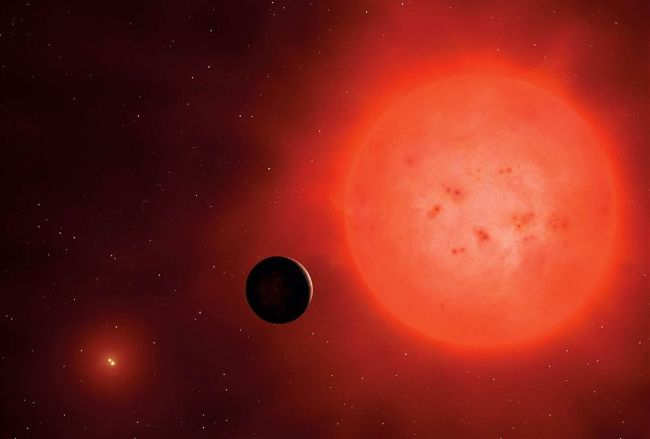
Late in 2021, astronomers simply couldn’t believe their eyes. The European Southern Observatory’s Very Large Telescope (VLT) had captured an image of a planet orbiting the two-star system b Centauri. It looked huge, and indeed it was, for this exoplanet has been shown to be a whopping 11 times as massive as Jupiter. It’s also a world that, in theory, still shouldn’t exist because the environment in that neck of the woods is rather hostile.
B CENTAURI B BY NUMBERS
11x more massive than Jupiter
18,000 Temperature, in degrees Celsius, of the main star b Centauri A
325 Distance from Earth to b Centauri in light years
560 Number of astronomical units between b Centauri b and its two stars
HIP 71865 Another name for the b Centauri two-star system
6x The two-star system is more massive than the Sun
zero Number of planets besides b Centauri b to be found around a star more than three times as massive as the Sun
20 Years since b Centauri b was first spotted
0.10- 0.17% Planet-to-star mass ratio
Prior to using the VLT, the only detailed studies performed for planets around large stars were carried out using a technique called the Doppler method. This indirect approach for finding extrasolar planets and brown dwarfs works on the principle that orbiting planets have a gravitational influence that causes stars to wobble. The bigger the orbiting body, the bigger the effect it will have on the star. As it wobbles, the star’s emitted light waves compress and stretch. Astronomers see this as a change in colour of the light, and it enables them to work out the motion and properties of a celestial body and the star it orbits – all without actually seeing the exoplanet.