Artemis
GOING BACK O THE MOON
THIS YEAR, NASA WILL TAKE THE FIRST STEP IN RETURNING ASTRONAUTS TO THE LUNAR SURFACE
Reported by Colin Stuart
It’s been a long time since a human voice bellowed from the lunar surface. This year marks half a century since Apollo astronaut Gene Cernan left the last footprints on the Moon in 1972, and a lot has changed since then. That year the first scientific handheld calculator was released; today we carry more computing power in our pocket than that which safely guided the Apollo astronauts to the Moon and back.
Now, at long last, humanity is about to leave low-Earth orbit (LEO) once again. Only two dozen astronauts have achieved that feat so far, all of them white men. Soon the first female astronaut and astronaut of colour will join the lauded lists of moonwalkers. It’s all thanks to the Artemis program – NASA’s plan to explore more of the lunar surface than ever before. By 2025 we could see astronauts walk in the lunar dust once more, with the upgrade from grainy blackand-white video footage that half a century of technological progress will bring. A whole new generation could see themselves as budding space travellers, inspired to dream big.
© NASA
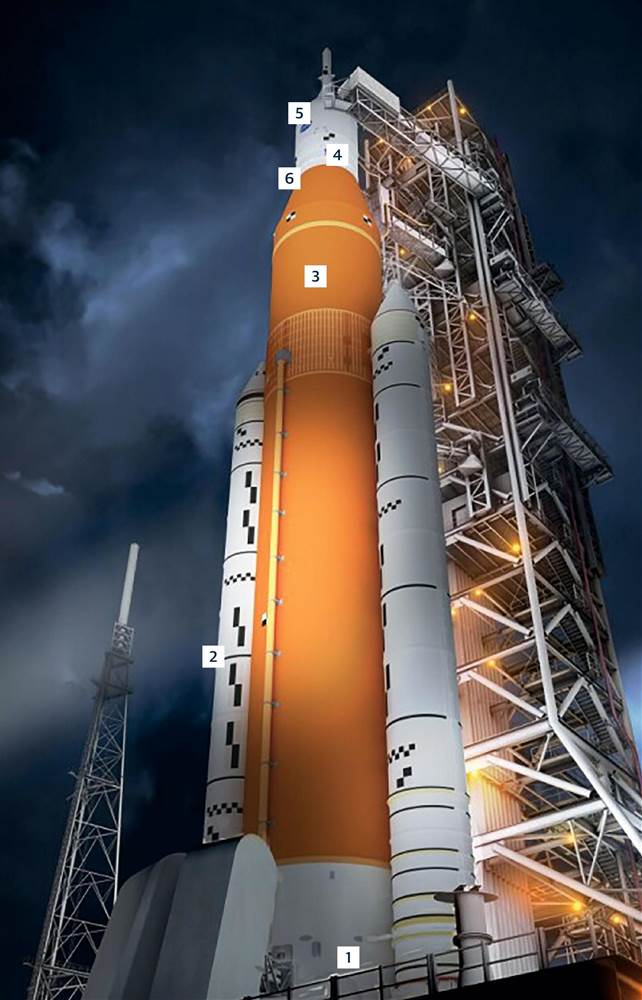
THE SPACE LAUNCH SYSTEM
It takes a lot of power to send 26 tonnes worth of cargo to the Moon
1 FOUR RS-25 ENGINES
NASA claims they’re the most efficient engines ever built.
2 SOLID ROCKET BOOSTERS
Each one is the height of a 17-storey building.
3 CORE STAGE
Contains almost 3 million litres of propellant, enough to power the engines for eight minutes.
4 ORION STAGE ADAPTER
Where small satellites are stored ahead of delivery to deep space.
5 ORION SPACECRAFT
The living quarters for the astronauts that will fly on future Artemis missions.
6 INTERIM CRYOGENIC PROPULSION STAGE
The juice needed for the final push towards the Moon once Artemis 1 leaves Earth orbit.
THE ARTEMIS 1 FLIGHT PLAN
Artemis 1 will take a highly detailed and complex loop around the Moon and then come back to Earth