MOON TOUR
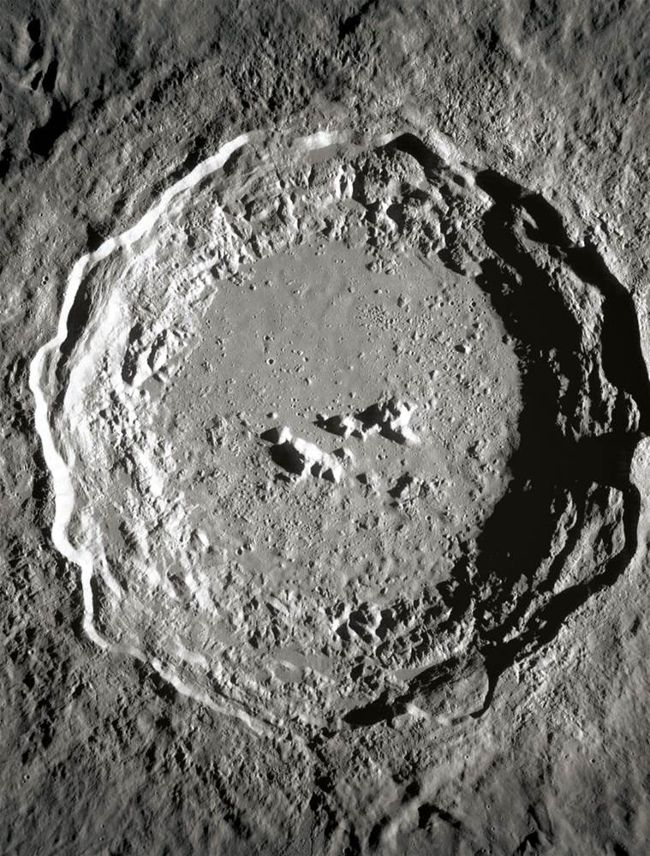
COPERNICUS
Early 2022 allows us to pay our respects to ‘the Monarch of the Moon’
© NASA
TOP TIP!
Copernicus looks most impressive just after first quarter or just after last quarter.
If you’ve ever seen a documentary about the Moon, you’ll have seen a scientist enthusiastically hurling a stone into a tray full of flour to demonstrate how impact craters are formed. Of all the hundreds of thousands of craters on the Moon, one looks exactly like the feature these dramatic demonstrations produce: a deep, sharp-edged pit, like a skull’s eye socket, surrounded by rays of debris.
Copernicus looks exactly like a lunar crater should: a great hole in the Moon with a dark, shadowed floor; a high-reaching rim and lots of bright rays of dust and pulverised rock splashing away from it. Its nickname, the Monarch of the Moon, is entirely justified – no other crater comes close to it for sheer ‘wow’ factor when seen through a telescope’s eyepiece. That’s why Moon observers go back to it again and again and again, staring down into it every chance they get.