FUTURE TECH
ORBITAL RINGS
These megastructures could ring around Earth to provide global transport systems
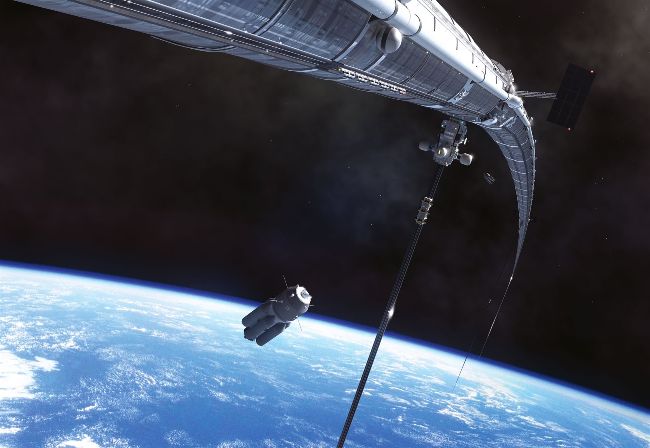
To provide a geostationary orbit
© NASA; Adrian Mann Orbital rings 25

the ring can be accelerated eastwards
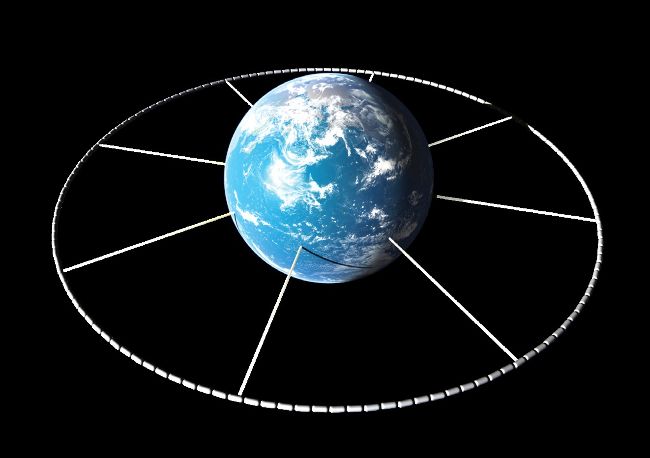
Causing the ring stations to remain over the same place on Earth
Today, transporting people and cargo into space is an extremely expensive, dangerous and time-consuming enterprise. It relies on rockets that can only take relatively small loads into Earth orbit. To make space more accessible, scientists have put forward the idea of building space elevators. These would consist of cables made of carbon nanotubes that would carry an elevator from the Earth’s equator to a geostationary space station linked to a counter-mass. Linked to the space elevator is the concept of creating an orbital ring or orbital ring systems. As early as the 1870s, inventor Nikola Tesla thought that a solid structure built around the equator would “float freely and could be arrested in its spinning motion by reactionary forces”. Using this orbital ring, he predicted that passengers could travel at a speed of around 1,600 kilometres per hour (990 miles per hour) around the globe.