MYSTERIES OF THE UNIVERSE
WHY DOES JUPITER CHANGE COLOUR?
For years, scientists have tried to work out why Jupiter’s bands frequently move and change colour. Now they believe they’ve found the answer
Reported by David Crookes
© Getty
Professor Chris Jones of the University of Leeds has been fascinated by Jupiter for more P than 60 years. He says that he became interested in what lies beneath the gas giant’s surface when he was a child, and since then his work has included many studies into the Solar System’s largest planet. He’s well aware of the many mysteries surrounding Jupiter, such as how it formed, the nature of its core and how it became enriched in heavy elements compared with the Sun. Scientists have also wrestled with the mystery of Jupiter’s colour-changing stripes, but this is something that Jones has gone a long way towards answering.
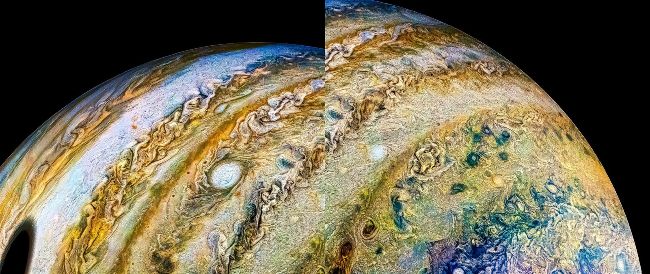
If you look at Jupiter, you’ll see many distinguishing features, not least the bands of colour and the famous Great Red Spot – apersistent highpressure region in the atmosphere which is twice as wide as Earth. The pale stripes are known as zones, while the darker ones are called belts. The belts are cyclonic and the zones are anticyclonic, and fast jet streams occur at their boundaries. “The colours of the features seen on Jupiter are a consequence of the rising gas brought up from the interior by convection,” Jones explains. “The striped appearance arises because there are very fast eastwest winds on Jupiter, so these gases rapidly spread out along lines of latitude.”
In other words, the strong winds give rise to the stripes, with the effect being bands of colour that swirl around. The mystery, however, lies in why the stripes change colour, size and location every four to five years. This phenomenon has been noted ever since Italian astronomer Galileo Galilei began to observe the gas giant in the early 17th century, and became clearer when the Hubble Space Telescope caught Jupiter changing its stripes via high-resolution images in the mid-2000s. Back then, Hubble’s Wide Field and Planetary Camera 2 captured entire bands of clouds changing colour, with zones darkening into belts and belts lightening and transforming into zones.