SOLAR SYSTEM
Will the Moon ever leave us?
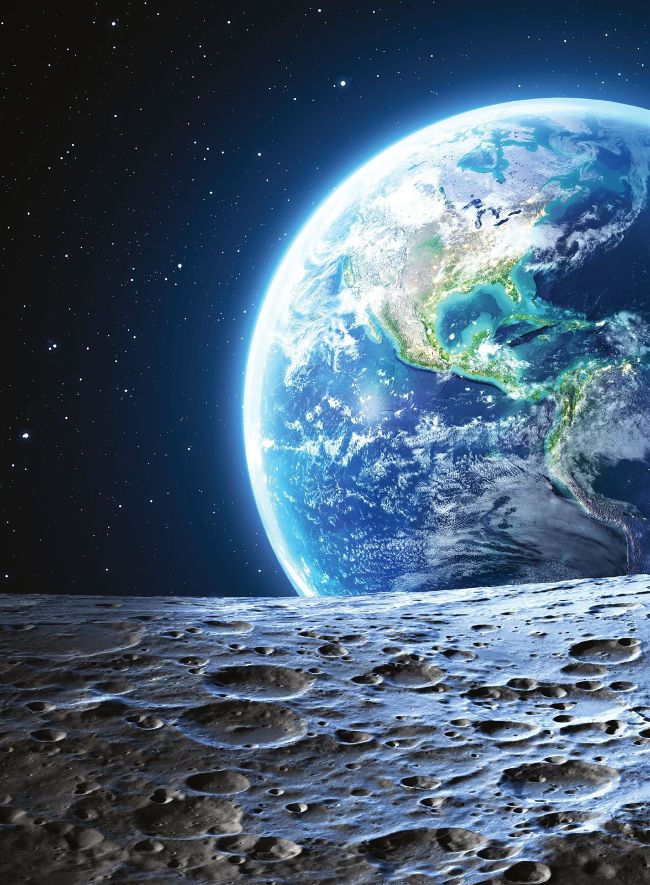
Artist’s impression of the view of Earth from the Moon
Ocean tides driven by the Moon release energy, but that energy has to come from somewhere – the spin of Earth, which must slow down. Physics dictates that the total amount of angular momentum has to stay the same between Earth and the Moon, so the orbit of the Moon has been getting larger for billions of years. How far can the Moon get from Earth, and can it ever escape and become its own planet? If Earth was to spin down completely, the Moon would get to the distance of 87 Earth radii – now it’s at 60 Earth radii. Calculations show that orbits closer than about 94 Earth radii are stable, so it looks like the Moon cannot escape, even theoretically.
To actually get to that distance the Moon may need about 15 billion years – much longer than the 5 billion years Earth has left – in which the Moon likely won’t get beyond 75 Earth radii. Also, the Sun’s tides steal spin from Earth, reducing what’s available to the Moon. Finally, Earth’s axial tilt will become chaotic in 1 to 2 billion years, misaligning the axes of Earth’s spin and lunar orbit and slowing the tides further. It appears that the Moon is here to stay with Earth until its end.

Matija Ćuk, research scientist at the SETI Institute
STARS
What are blue large-amplitude pulsators (BLAP) and how do they differ from other pulsating stars?
Blue large-amplitude pulsators are almost half an hour pulsators, so their pulsation periods are between 20 and 40 minutes, and they have exceptionally large amplitude changes. They differ from other variable stars because of the high amplitude change in very short periods. We know the classical Cepheid, RR Lyrae and Mira stars are variable stars of much longer periods, consisting of days, weeks or even months. If you compare these BLAPs to Cepheids, Cepheids extend over a larger fraction of the star’s magnitude, but their periods are much shorter. If we compare this to our Sun, a typical BLAP is about 70 per cent the diameter of the Sun. However, the change in the surface is remarkably large, because more than ten per cent, about 13 per cent, is the change in the BLAPs’ diameter. If you imagine it takes only half an hour to make this change, it goes incredibly fast. What differentiates this pulsator from others is that other pulsators are mostly red giants, which are cool stars of about 3,000 to 5,000 Kelvin. These BLAPs are variable stars that are very hot. They have temperatures of about 30,000 Kelvin, making them appear blue.