HEROES OF SPACE
CARL SAGAN
From giant stars to the smallest mote of dust, Sagan helped popularise space like never before
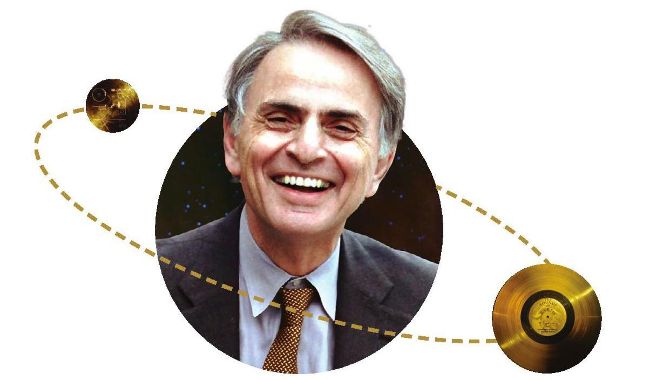
Sagan was born on 9 November 1934 in New York. It was at the 1939 New York World’s Fair where he first encountered science and astronomy. His imagination was captured by a time capsule containing memories of the 1930s that was buried for future generations to uncover, and this inspired him to create the Pioneer plaque and Voyager Golden Records – memories of Earth that would be sent far into the cosmos aboard their respective spacecraft. His interest in space led him to the University of Chicago, where he achieved a PhD in astronomy and astrophysics. Throughout the 1950s he worked as an adviser to NASA, which included briefing the Apollo astronauts and working on experiments for the Galileo and Voyager spacecraft, among others. Some of his major scientific achievements occurred in the 1960s, starting with his conclusion that Venus was a scorching world with a thick atmosphere, rather than a moderate Earth-like paradise. This theory was proved correct by Mariner 2 in 1962. He was also one of the first scientists to suggest that Saturn’s moon Titan might have liquids on its surface, and he helped study shifts in surface dust on Mars. Some of his most famous research concerned extraterrestrial life, which he was sure existed.