USER MANUAL
SUBARU TELESCOPE
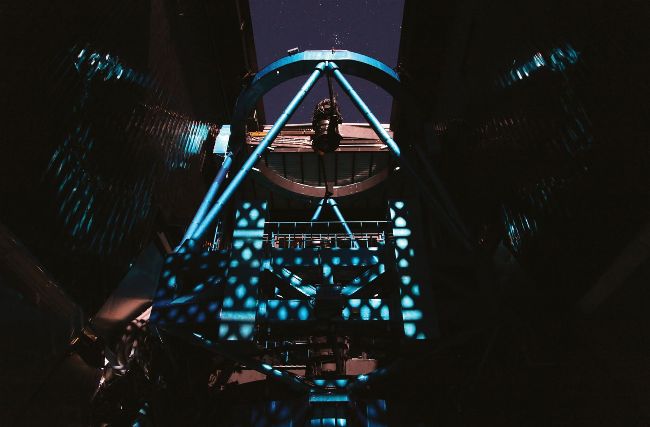
The Pleiades and Jupiter glistening above the telescope
SPECS
First light: January 1999
Primary mirror size: 8.2 metres (26.9 feet)
Primary mirror thickness: 20 centimetres (7.9 inches)
Location: Mauna Kea Observatory
Operator: National Astronomical Observatory of Japan
Sitting top of the dormant volcano Mauna Kea in Hawaii, the Subaru Telescope takes S advantage of one of the best astronomical observation sites on the planet. When the National Astronomical Observatory of Japan (NAOJ) commissioned the telescope in 1991, the organisation set out to build the best optical and infrared telescope possible, capable of discovering the secrets of the cosmos. And although ‘Subaru’ is a name commonly associated with automobiles, it originates from the Japanese name for the young cluster we know as the Pleiades (Messier 45). Not only is it another name for the ‘Seven Sisters’ in the constellation of Taurus, it also means ‘tie together’ in Japanese.
Construction began at the Mauna Kea site in June 1992 and was completed in December 1998, with scientific observations starting in January 1999. Some of the first light observations included the Orion Nebula (Messier 42), the spiral galaxy NGC 4051 and Abell 851. The construction process was a long and arduous journey. Engineers and scientists wanted to create the thinnest primary mirror possible, combine it with the latest technological advancements and enclose it within a state-of-the-art protective cylindrical dome that helps minimise air turbulence within the telescope’s enclosure.