NEXT GIANT LEAP
We’ve gone from biplanes to Falcon 9 in a century. What will the next 100 years bring?
Written by Luis Villazon
106 years ago, the Smithsonian Institution gave Robert H. Goddard a $5,000 grant to pursue his early experiments with rockets. Today, NASA’s budget is $25.4 billion (£19.9 billion), and private companies spend even more building and launching commercial satellites. The next 100 years will see the privatisation of space, not just of telecommunications, but also basic research and exploration. New ways of reaching space and reusing spacecraft will dramatically cut the cost per kilogram of payloads, and advances in robotics and guidance will make the journeys much safer. Space travel won’t just be for astronauts than air travel is just for pilots.
All About Space chats with experts in different areas of aerospace research to try and get a glimpse of the progress that could be made in the next century. But extrapolating existing trends is always risky – 100 years ago, who would have predicted YouTube or the GPS satellite network? But even the most cautious fortune-tellers agree that our great grandchildren will quite routinely journey further and faster than the most experienced astronauts working today. The horizons of our world are about to expand in a way that hasn’t been seen since Ferdinand Magellan first set off to circumnavigate our tiny blue world.
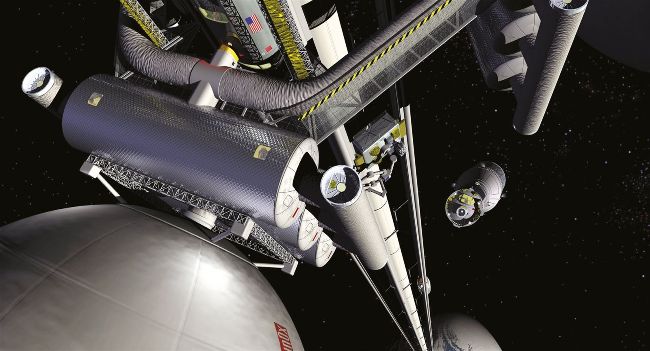
An artist’s impression of a space elevator looking down at Earth
Space elevator
A LIFT TO THE MOON
A working space elevator has been the Holy Grail of space travel since Konstantin Tsiolkovsky published the idea in 1895. But the biggest hurdle so far has been finding a material strong enough to withstand the 50-gigapascal tension that the cable would need to handle. Large-scale carbon nanotube fibre currently has a tensile strength of just one gigapascal, and steel isn’t much better at 4.8 gigapascals. Carbon nanotubes could become strong enough theoretically, but we’re currently unable to assemble them. Recent studies found that even a single atom out of place could halve the strength of the entire cable. On the Moon, where the gravity is only onesixth of Earth’s, the stresses are much lower, and an elevator made of kevlar could be feasible. Scientists have managed to synthesise diamond threads, which are even stronger than carbon nanotubes, and boron nitride nanotubes which have selfhealing properties, capable of repairing micrometeoroid damage.