HERE, THERE AND EVERYWHERE
NAVIGATION SKILLS ARE ESSENTIAL IN THE WILD.
BY RYAN LEE PRICE
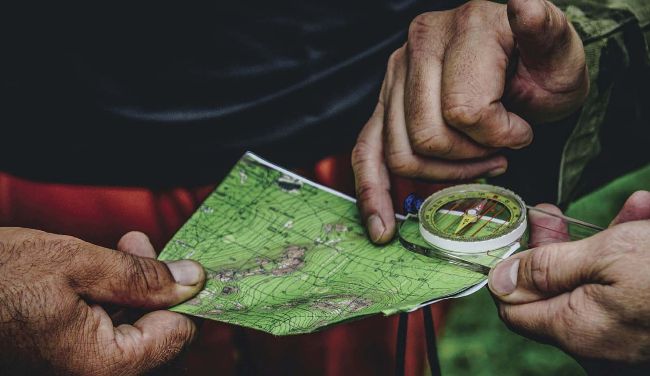
Being able to read a compass and orient a map are important skills that can keep you from getting lost in unfamiliar territory.
Stepping off the trail and heading up a canyon for a mile or so is enough to get a person lost. The twists and turns of a benign-looking range of hills and arroyos can be confusing, especially if you add to it the fears of survival, the pangs of hunger or the parched dryness of thirst.
You know where you came from-perhaps a broken-down car or last night’s camp-and you know where you want to go: civilization.
But you’re not sure how to get there. You need to get from point A to point Z, and you’re on foot. You’ve never done that before, so you’ll have some challenges.
To help overcome some of those challenges, you’re prepared, because you have in your pack a map of the area and a compass … right?
1.0 MAP AND COMPASS
A map of your terrain is always more important than the compass, although you should always consider them as a unit. You can use them independently of each other, but a map, alone, can be complemented by nature’s compass. If you only have a compass, you can accurately travel in a straight line for miles through fog or forest and then go back the same way you came.