THE MAKING OF 750.. GRAND PRIX
INSPIRED BY SUPER HANG-ON AND HAVING SEEN HIS PREVIOUS RACER ZOOM TOWARDS THE TOP OF THE CHARTS, TWIN TURBO V8 DEVELOPER KEN MURFITT PRODUCED A SUPERFAST, GRAPHICALLY STUNNING MOTORCYCLE GAME FOR THE AMSTRAD CPC THAT COULD DRIVE PLAYERS ROUND THE BEND
WORDS BY DAVID CROOKES
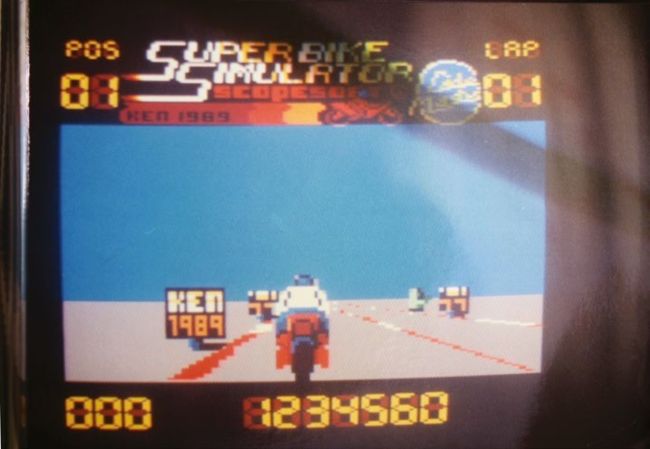
» Ken took a photo of the game’s screen when it was set to be called Super Bike Simulator.
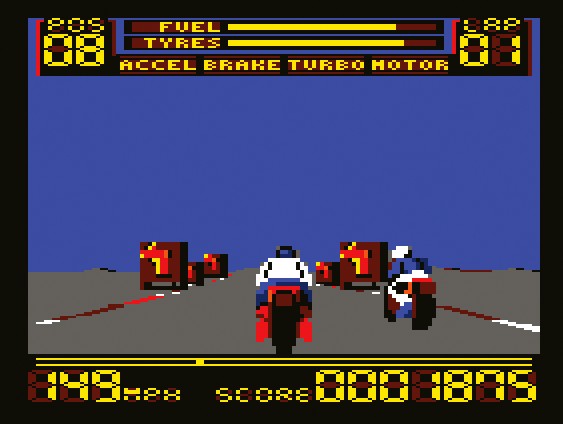
» [Amstrad CPC] You’re racing against opponents rather than against the clock in this game.
In March 1985, almost a year after the Amstrad CPC 464 was released, Ken Murfitt’s father won a rather lucrative competition. He’d entered a character modifier app called Symogen 464 into a coding contest being run by Amstrad Computer User (ACU) magazine and bagged himself an impressive £2,000.
Inspired, Ken began programming his own CPC titles, starting with a formula one simulator called Racer which he coded in BASIC. “It really shows what can be done without resorting to machine code,” the magazine said of an entry which won Ken £600. With four circuits, tricky bends and clever use of ink switching which allowed for a speeding track effect, this game put Ken on the road to commercial success.
Having decided to learn machine code, Ken began to code another racer inspired by Sega’s arcade driving game, Out Run. Codemasters agreed to publish what became Twin Turbo V8 and it hit the shop shelves in 1989 after which it performed well both in terms of its on-screen abilities and sales.
This prompted the publisher to commission another motor-inspired game, this time based around motorbikes. “They asked me to do it and I was quite pleased,” Ken says. “The publisher wanted this one to be like Super Hang-On and it seemed like the Codies were looking to create clones of the major Sega arcade titles for the Amstrad.”
“IT SEEMED LIKE THE CODIES WERE LOOKING TO CREATE CLONES OF THE MAJOR SEGA ARCADE TITLES”
KEN MURFITT
Codemasters envisioned it would be called Super Bike Simulator in line with so many of its other titles and Ken was left alone to figure out how best to tackle the project. He felt the CPC would be the natural platform “mainly because we, as a family, owned a CPC”. Ken also believed there would be many benefits from targeting Sugar’s machine. “The market for the ZX Spectrum and Commodore 64 was already crowded and sometimes it pays to serve the underrepresented market,” he says. “I also happened to love the video colours on the CPC – that pink and orange – and I felt the CPC also had a fantastic keyboard – at least the earlier CPC models did with the taller keys before the cost-reduced keyboard came out.”