readers’ homes
MOVING FORWARD
Faced with a decision to either renovate an old mill or take on a plot with lapsed planning, Katy and Alan Pateman crunched the numbers and – with support of a builder friend – embarked on the journey to creating a stylish oak frame cottage
WORDS JANE CRITTENDEN
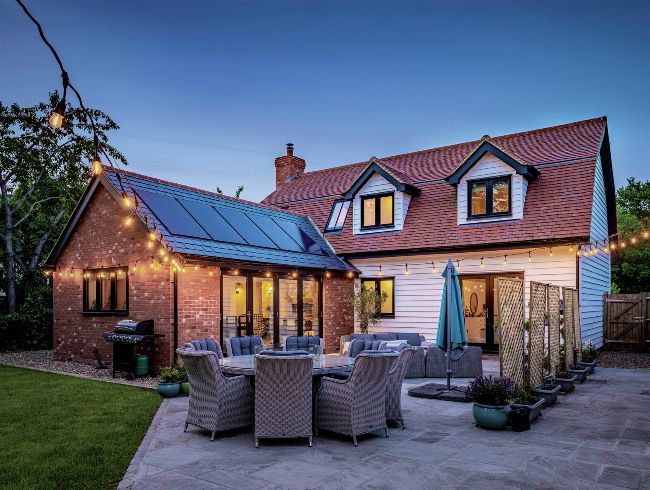
Solar PV panels from Green Building Renewables, who the couple met at a Build It Live show, were a planning requirement. They meet the family’s electricity demand during the summer months
PHOTOS NIKHILESH HAVAL
Not long after Katy and Alan Pateman had downsized to a riverside new build townhouse in Essex, where they planned to semi-retire, they had an idea to self build. Problems with the property management committee had started to cast a dark shadow over their lives, and the couple made the brave decision to move out. Leaving their house empty, the couple rented a friend’s annexe in a village on the Blackwater estuary, along with their teenage son, Frank. It was here they spotted a plot for sale and began to ponder an alternative route.
“We liked living in the village because it was beautiful and peaceful, with a small school, church and a pub. However, there were not many properties coming on the market,” says Katy. “We saw the plot, but the thought of self building was beyond us, we didn’t even really do any DIY!” The land had previously been an allotment next to the village hall. It had lapsed outline planning for a two-bedroom, Essex-style cottage and had been on the market for three years. “A friend of a friend owned the land, so we were aware it had a rather tricky planning history. The site also had no access to water, sewage or electricity,” says Katy. “Our other option was to renovate an old mill house that was up for sale in the next village.”
Self build or renovate?
The couple put their townhouse on the market and took time to review both projects in more detail. Although the plot was inside the defined settlement boundary of the village, it was also within a conservation area – part of the reason the landowners had found it so tough to get planning approval. “We knew we wouldn’t be allowed to build just anything on there,” says Katy. “We found out that five different designs had already been rejected, with the lapsed scheme – and an updated version – the only one accepted.”