INSTALLINGA WOODBURNING STOVE
There’s more to choosing the right woodburner than aesthetics and out-of-the-box efficiency.Jane Crittenden looks at how to ensure yours is correctly fitted to ensure optimum performance
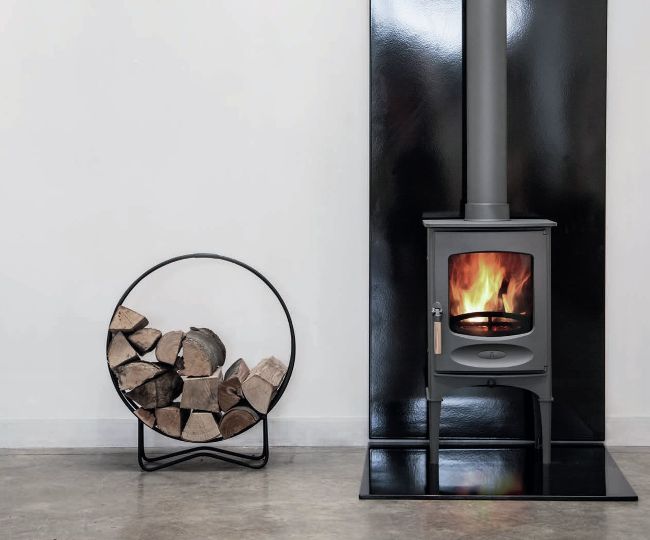
Above: The Charnwood C4 BLU is Ecodesign Ready and shown here on a Vlaze hearth with a wallmounted heat shield that allows a shortened distances to combustibles.Priced from £1,152 for a 4.9kW model, Woodburner Warehouse
Nothing beats sitting around a cosy woodburning stove on a dark winter’s evening. But to stay safe at home and maximise the performance and efficiency of your appliance, it’s vital that it’s properly installed. Before you get started with talking to suppliers and fitters, this article will help you familiarise yourself with some of the key points you need to know.
An overview
There are lots of details to soak up – woodburners must comply with rules set out in Approved Documents F, G, J, L and P of Building Regs. Broadly speaking, the fireplace opening or wall cavity (for an inset model) must be made of non-combustible materials, such as brick or stone, and the chimney must be sound so fumes don’t leak into the house. There are specifications for the distance between the stove – or steel flue pipe for installs without a chimney –and combustible materials, such as plasterboard, carpet, wood lintel, furniture. This is important as it affects the final position of your appliance and how much floorspace it might take up. Details vary according to the manufacturer’s instructions for individual products. In the case of exposed flue pipes, distances can be decreased providing the wall is protected with a heat shield panel.
The hearth must be made of non-combustible materials – slate, stone, brick, toughened glass, tile – and there are regulations regarding appropriate sizes and depths. All installations need a carbon monoxide detector and smoke alarm, and when the work is finished, it needs to be signed off by a local building control inspector or self-certification by an installer registered with a competent person’s scheme. One example is HETAS (Heating Equipment Testing and Approval Scheme), which works closely with the government and industry experts, setting the benchmark for best practice in the industry.