Rotational Pasture
column by Frank Hyman
I had to learn the hard way that allowing our chickens to free-range in the yard — as some experts advise — leads to my having to free-range the yard as well: removing poop from the patio, replacing mulch and replanting uprooted flowers. Oh, you too?
So perhaps the term “free-range” overprom-ises just a bit. It’s not really free if you have to give up your free time to fix things. Maybe a term such as “home-range” would be more accurate — meaning that we give the chickens special places where they can feel like they’re home-on-the-range and we feel like we’re home free.
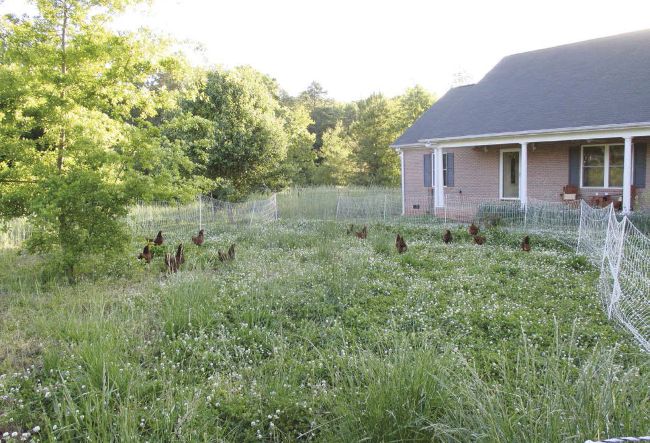
Shawn and Stephanie Jadrnicek’s front yard is a poultry pasture full of while clover, grasses and other chicken treats, including bugs. A portable electric poultry netting encloses it, keeping four-legged predators away.
PHOTOS BY SHAWN JADRNICEK
For my tiny homestead on a 1⁄4-acre in downtown Durham, North Carolina, my wife and I enclosed a small area under a cluster of shrubs to create a home-range we call the Corral or the Forest Grove for our half-dozen hens.
But that wouldn’t be adequate for chicken-keepers with more land and more chickens. Fortunately, my colleagues — Shawn Jadrnicek and his wife, Stephanie — have confronted the same issues and come up with the kind of low-cost, low-maintenance, high-success system I can appreciate.
You can find details on their system and other great innovations for the small farmer or homesteader in their book The Bio-Integrated Farm: A revolutionary permaculture-based system using greenhouses, ponds, compost piles, aquaponics, chickens and more. But I’ll summarize their rotational “pasture pens” here.
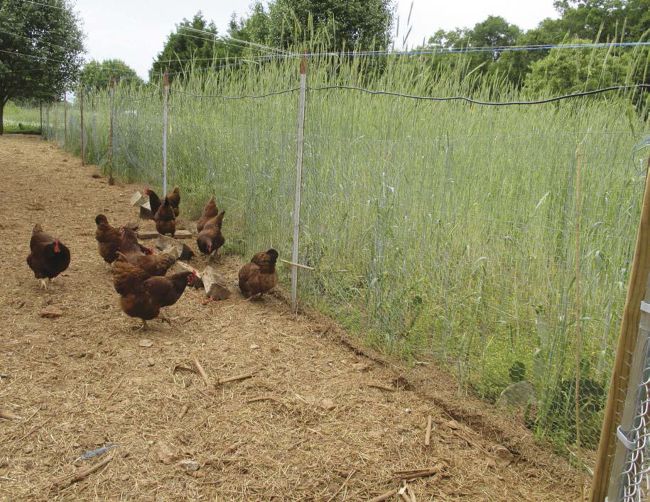
Chickens inside the alley anticipate a field trip into the pasture planted with rye grain. When ripe, Shawn Jadrnicek will cut them down with a sickle mower so the chickens can gobble up the grains. The alley is mulched to reduce muddiness.