GB
  
You are currently viewing the United Kingdom version of the site.
Would you like to switch to your local site?
21 MIN READ TIME

> 60 years of the synth

The 70s

Once the 60s had laid down the framework, the 70s picked up the baton and turned the synthesiser into a musical entity and idiom. It started off being used by the rich kids and then the very cool kids…
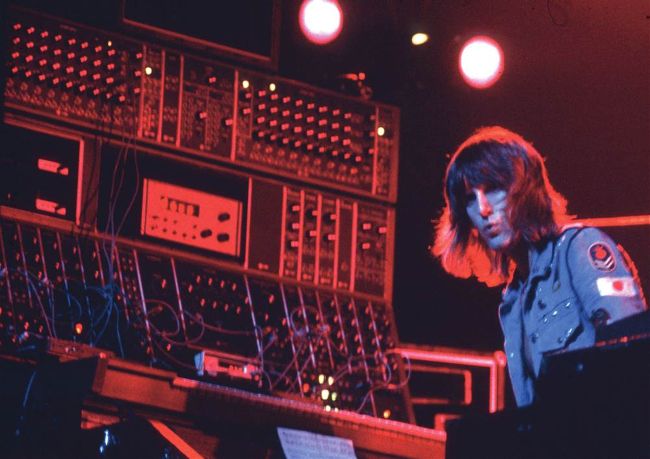
Getty

The 70s is the decade when this new musical synth technology began to really find its feet. Granted, it was still an incredibly expensive preoccupation, but synthesiser development continued with the American companies leading the charge, while new horizons appeared from the east.

Alan Robert Pearlman was a designer, electrical engineer and inventor, who spent five years working at NASA. In 1969 he founded his own company, formed from the initials in his name. ARP instruments Inc, (originally branded as Tonus Inc.) were to become a major player in the synthetic arena, beginning on the dot of 1970 with the release of the ARP 2500. Like many of its predecessors, the 2500 was another modular behemoth. Many people regarded it as being a rather overwhelming instrument to use, being confronted by a multitude of modules, ranging from oscillators, filters, LFOs and VCAs, to a dedicated sequencer and keyboard. You certainly got a lot of sound creation potential for your money, which was just as well because the synthesiser cost £5400 for what was deemed to be a standard configuration.

The role of ARP in the development of synthesis is of great importance, as it provided a very different colour palette to that being created by Moog. Some aficionados actually went further, commenting that the ARP oscillators were far more stable at holding pitch. Harsh words, but forgotten pretty quickly in the same year, when Moog released the synthesiser that would go on to become the most revered and coveted machine of them all; The Minimoog.
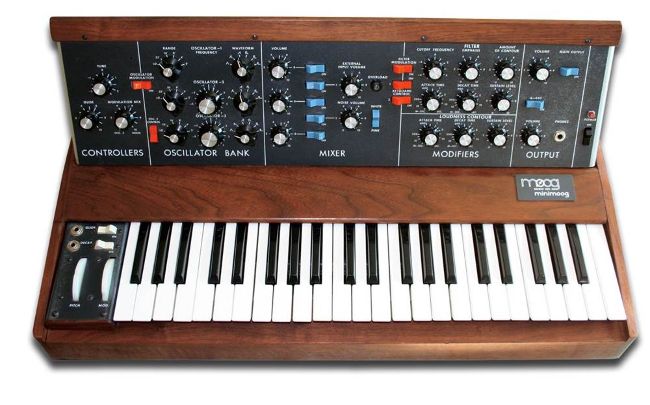
Convenient, powerful and sort of affordable, the Minimoog was many a player’s one true love

Take the Mini for a spin

There was an awful lot to shout about. Firstly, the Mini adopted a form that made it truly engaging. Its panel and fascia could be propped up at an angle, which invited the user to get creative with sound, with a 37-note keyboard for instant playability. Unlike just about all predecessors, the Minimoog was not modular, or even semi-modular, meaning that patch cables were not required. It hosted three incredible-sounding oscillators, all routed in the direction of the now legendary Moog 24dB/4-pole low-pass ladder filter. Users often described its power, which for the first time offered something to keyboard players that could truly compete with the guitarist in the band! Then there was the price; at just over £600, it was still very expensive, but relatively affordable if compared to anything else on the market, and that made it a prospect for many keyboard players to place on top of their Fender Rhodes electric pianos. It is worth noting that the Mk1 Fender Rhodes had a curved top, leading to the spectacle of many Minimoogs being gaffer taped, to prevent them from moving around, while being played.

Meanwhile, in 1971 yet another legendary machine appeared from the ARP stable, in the form of the semi-modular ARP 2600. It was smaller and more portable than the 2500, but still offered three oscillators for a monophonic voice, in a more versatile routing architecture. It underwent numerous revisions, over a tenure that lasted ten years, while being regarded as one of the absolute greats.

Enter the Brits

Not to be outdone, the Brits got in on the action the following year, with the introduction of the EMS Synthi 100. Unlike the Minimoog, this was another behemoth of a synthesiser, mustering an enormous 12 voltage-controlled oscillators, two noise generators, three ring modulators, and four low-pass and high-pass filters. It was also very large, and very heavy, with an initial cost of £6500.

Unlock this article and much more with
You can enjoy:
Enjoy this edition in full
Instant access to 600+ titles
Thousands of back issues
No contract or commitment
Try for 99p
SUBSCRIBE NOW
30 day trial, then just £9.99 / month. Cancel anytime. New subscribers only.


Learn more
Pocketmags Plus
Pocketmags Plus

This article is from...


View Issues
Computer Music
May 2022
VIEW IN STORE

Other Articles in this Issue


welcome
welcome
DOWNLOAD See page 81 to find out how
Essentials
Steinberg Cubase 12
Cubase have just announced version 12 of Cubase, so in our excitement we’re doing a news special to give you the full lowdown on what to expect
12 of 12’s best
New season, new update, new features
COMPUTER MUSIC
10 years back
BACK ISSUES
Catch up what you've missed - all of these issues include FileSilo downloads!
Next issue
80 plugins, big workshops!
Cover feature
THE HISTORY OF ELECTRONIC MUSIC
We’re covering 60 years of the synthesiser in this issue but, as we discover as we look back in time, the synthesiser and electronic music were actually with us well before the 1960s. Here we break down their history into component parts – ironically, rather like a modular synth – and discover their rather ‘shocking’ beginnings…
THE 60S
As we begin our sojourn through 60 Years of the Synth, we go back to the 1960s to consider where it all started, laying praise at the door of the synth forerunners and revealing the first ‘proper’ synth from 1962…
6 of the best 60s plugins
Arturia Modular V Mac/PC €149 One of the
Top ten of the 60s
The people and tech that launched a thousand cultural movements
The 80s
All analogue and chipsMonoPoly was an ingenious
cm/expert guides
#03 Audio interface bass
Continuing our perfect bass production journey, let’s learn how to record and enhance a clean bassline through an audio interface
#13 Metallic keys
Want to wake up your inner sound magpie? Create something shiny with ZebraCM, as we get all metallic with those keys
Reviews
Wave Alchemy Triaz £119.96
Wave Alchemy’s triple-pronged beat-making beast serves an enticing new way to sculpt your rhythms, with pro-sounding beats on-tap
Orchestral Tools Andea by Richard Harvey €399.00 PC MAC
With an emphasis on world instrumentation, OT’s latest suite whisks us off to the central and southern Americas, in search of Andea
Applied Acoustic Systems Multiphonics CV-1 $99.00
Going Modular needn’t be all about the hardware and expense. We head for our desktop and grab a virtual cable or ten!
Loopmasters Loopcloud Drum and Play £69.95/£29.95
Two of Loopcloud’s bespoke tools now stand alone as adept beatbuilders and synthetic colour generators respectively
Spitfire Audio Abbey Road Two: Iconic Strings Professional £449
Adopting an intimate persona, Spitfire’s latest sample-based suite pops iconic strings right inside legendary surroundings
Excite Audio Lifeline Expanse £50
Confidently calling itself the only multi-effect plugin you’ll ever need, is Excite Audio’s life-giving new star really the track sprucer it claims?
Odd Studios ODD Ball £95
Is this for real? A MIDI controller without pads, keys, or even corners. Just bounce it, and watch out for your studio fish tank
cm mini reviews
A rapid-fire round-up of hardware, samples, and much more
IK MULTIMEDIA SYNTRONIK 2 J-60
Get to know this month’s addition to our plugin arsenal, IK’s take on the iconic Juno-60 polyphonic synth
4 new synth packs!
It’s 60 Years of the Synth this issue and we’re tapping the first 40 for our all-new sample packs! Download them from filesilo.co.uk or wetransfer
cm/video
Download this month’s videos: filesilo.co.uk/computermusic cm/experts Our resident
cm/15 Questions with…
Hinako Omori
Hinako Omori combines analogue synths with plugins to mesmerising effect, with her new album – recorded at Real World Studios – dazzling with rich textures and transformative atmospheres…
Chat
X
Pocketmags Support