reader music
A classic Computer Music feature returns in a bi-monthly slot where the focus shifts to you and your music. Will you dare to send your tunes in and get the cm critique? These people did…
As promised in
Backchat
a few issues back, we’ve brought back a vintage feature where your tunes get put under the spotlight. It’s a great way to get feedback on your music, and not just from us as all readers can check your tunes out. And as
they say, there’s actually no such thing as bad publicity.
How it works: email computermusic@ futurenet.com with your bio, photos (moody press shots allowed) and links to your music. We’d also like your influences plus an outline of what gear you use. Then, space allowing, we’ll interview one lucky entrant each issue. For our first outing in this issue we have three entries: from Chris Carbinax (who gets the prized main spread interview slot), Reev Robledo and Andy Warburton.
Carbinax
Carbinax is the musical project of Chris Carbinax, a Northern Ireland-based producer. He says, “It is the result of a number of years learning, striving, pulling all-nighters, obsessed with finding the secret chords, the elusive beats, exact ingredients and blueprints necessary to make electronic music that is sublime, experimental, meaningful as well as melodically memorable.”
Chris has been releasing music as Carbinax since 2016; before that he was known as 2ndMOUSE, (after the Christopher Walken speech in the movie Catch Me If You Can). He tends to produce in a lot of different electronic genres - and as we see here he works on a lot of different tracks simultaneously - and releases all his music as albums (CD and vinyl) on his own label.
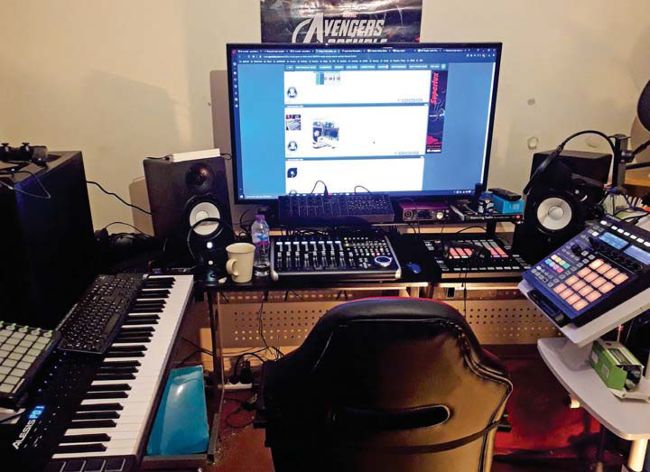
The machines at the heart of the Carbinax studio help him produce everything from ambient to techno
ARTIST INTERVIEW
cm: Tell us a little about your music background?
Carbinax: “It started when I was 10 when I heard Kraftwerk’s The Model. It was an epiphany - I knew I had found my music. I listened to Jarre, Vangelis, all the 80s new wave and became a big fan of Howard Jones and Depeche Mode. I had some Yamaha and Casio home keyboards, but it wasn’t until the late 80s that I got into acid house and finally Detroit techno, and it was only then that everything came together and I knew I wanted to make electronic music seriously. It still took a few years to get to the point of making it on a computer. At one point, I had a Roland D-20 and a Fostex 4-track. Then I got a Playstation and I bought a ‘game’ called Music 2000 which was incredible. It was probably my first rudimentary DAW, and I could load samples into it, and somehow I found out that this magazine called Computer Music also had samples on the disc, so I started buying it regularly for that. I then discovered I could do everything I imagined on a computer, so I absolutely had to get one.”