YELLE
Jean-Francois Perrier tells us how the French act came to top charts on both sides of ‘le pond’, how napping is key to any workflow and shares some timeless advice from Phillipe Zdar
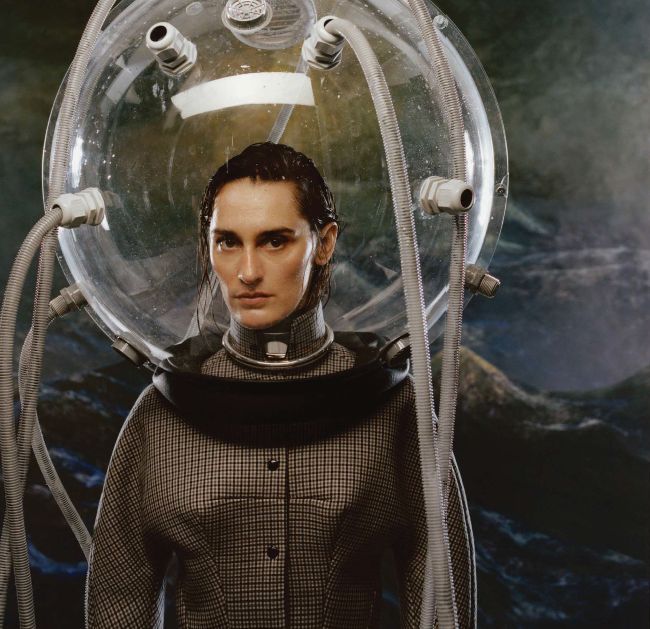
Photo: Marcin Kempski
Yelle’s music seems to belong in the city. The dirty synth basslines and clattering electronic rhythms of songs like
Karaté
or
Ba$$in
are tailor-made for the neon-soaked streets of LA or Tokyo. And then there are Julie Budet’s vocals: Madonna meets Francois Hardy in some sleazy, backstreet Parisian bar. Even their videos seem to exude a disturbing, futuristic glamour. Dystopian vignettes with an impish sense of humour and style.
It’s surprising, then, to find the Yelle studio perched atop a lonely clifftop on the Brittany coast. The views are breathtaking, with the vast sea and sky visible from every window.
“This place is very peaceful,” admits Jean-Francois Perrier, the technical half of Yelle. “Earlier this morning, I was walking with my friend and we could hear nothing. Some people need the noise of the city to help them create music, but we prefer silence. I don’t really listen to much music at all, not even when I’m driving. It’s better that I have some space in my head… space for the ideas to happen.”
There’s a common misconception that France’s relationship with dance music begins in 1995 with the release of the Daft Punk single Da Funk. Then, along came Air, St Germain et al, and suddenly everyone was talking about the ‘French touch’.
In truth, the story starts way before Bangalter and de Homem-Christo. As well as the twisted funk-pop of Les Rita Mitsouko and René Roussel in the 80s, French acts had a huge impact on 70s disco. Cerrone, Gibson Brothers, Sheila and B. Devotion, Ottawan, plus synth-heavy grooves from the likes of Space, Droids and (of course!) Jean-Michel Jarre.
Perrier’s own introduction to dance music came via the Beastie Boys. “I was aware of French dance music, but I thought it was boring,” he laughs. “I didn’t get it. I played drums in a rock band and all I cared about was Rage Against the Machine. After I heard the Beastie Boys’ Hello Nasty album [1998], I started make the connection between Rage Against the Machine and dance music.”
For singer Budet, music runs in the family. Her father had a minor French hit in the 60s and her earliest memories are of going to see him play live. “I was surrounded by music. There were lots of instruments in the house and different singers staying with my father. There was always music on the radio or someone playing records. The house had a lot of soul.”
Budet and Perrier have been a couple for almost 20 years, but only started making music around 2005. An early demo found its way to EMI and, much to their surprise, they were offered a deal. “We didn’t tell them that we only had three songs,” admits Perrier.
Despite singing exclusively in French, Yelle’s music quickly found its way over to America and to the rest of Europe - notably, all three of their previous albums have made the Top Ten in the US Dance charts.
The latest album, L’Ère du Verseau has just been released, and includes the recent singles, Karaté and - arguably one of the most beautiful songs of the year - Je T’aime Encore.
“For many years, I didn’t care about chords or melodies. I just wanted to make people dance”
The couple live together, but Perrier - over Skype - handles most questions, occasionally checking a name or detail with Budet.
“There are times in the studio where I spend two days moving hi-hats and snares to get a beat to sound human and I think Julie doesn’t enjoy it too much. Like most normal people, she would rather be downstairs sleeping!”
cm: You live together, you’re a couple and you spend most of your time making music together… has that ever come to cause you any problems?
Jean-Francois Perrier: “Not too much. The only time there is tension is when we are recording vocals. I have a strong idea of how I want the words to sound, but Julie is the singer and she also knows how she wants to create the vocal. In the past, it was a battle, but we found a solution. When it’s time for the vocals, I leave the studio and we have a friend who looks after the production. It’s much better for everyone!”
cm: Rhythm is a key component of most Yelle songs. Presumably, that comes from your days as a drummer?
J-FP: “Drums was the first instrument I fell in love with as a kid. Even if I saw a band on a TV show, I was fascinated by the power they gave to a song… the big cymbals. Eventually, I managed to find a pair of sticks and started playing on some containers and pillows in my bedroom. My parents realised this was something I cared about and arranged for some lessons with this old guy, a blind drummer. All he had was a kick and snare, but that’s where I really learned to engage my ears. To work out how the drums can assist a piece of music.