jubilee weekend.
OLD SCHOOL meets NEW SCHOOL
What were the British eating back in the early 1950s, during post-war rationing, when Queen Elizabeth came to the throne? Much fun is made of Britain’s culinary heritage (or lack of it) – some of it justifiably so. But look closer and there are gems to be found.
Through innovations that made the best of rationing, the use of preserving techniques we now revere or the invention of one of our best loved treats, Britain’s history in the kitchen has much to offer the keen student.
To celebrate the Platinum Jubilee, food writer Rebecca Woollard has taken five British staples from days gone by and looked at them with fresh eyes. Each has proven its worth in history, and we hope you enjoy the updates as much as previous generations enjoyed the originals. →
RECIPES & WORDS: REBECCA WOOLLARD. PHOTOGRAPHS: NASSIMA ROTHACKER. FOOD STYLING: SOPHIE PRYN. STYLING: MAX ROBINSON
We’re all familiar with the Dig for Victory campaign set up during World War II. Parks and gardens were turned into allotments to provide vegetables that could be used to bulk out meals in place of rationed items.
Flour and butter were scarce, so potatoes were used to make pastry.
This ingenious method not only produces a dough that’s absurdly fun to work with, but the result is also delicious – like the crusty top of an enriched bread. And since you can’t move now without someone telling you to eat less meat, the wartime veg-heav y pie filling seems appropriate, too. If you can, try to find beef shin. It’s by far the best cut for slow cooking and the collagen in it naturally thickens and enriches the gravy.
Meat and potato pastry pie
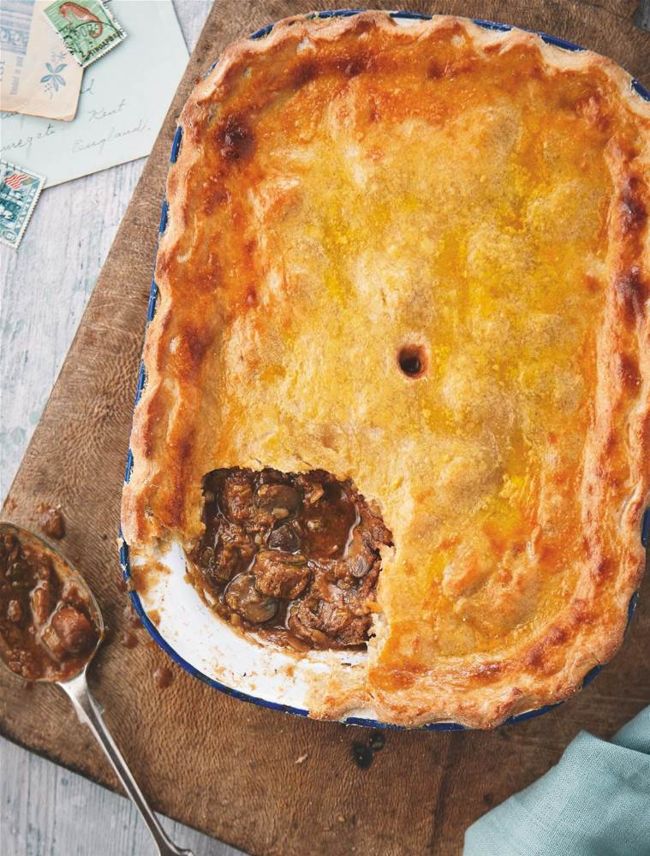
Oh what a lovely pie – dig in!
Serves 4-6 (or 8 wartime portions) Hands-on time 1 hour 10 minutes, plus chilling and cooling Oven time 3 hours 40 minutes Specialist kit Large pie dish, about 30cm x 20cm
MAKE AHEAD
Make the filling and pastry up to 2 days ahead, or freeze separately for up to 1 month.
The assembled, unbaked pie can also be frozen, well wrapped, for 1 month. Defrost in the fridge before baking as in the recipe.
KNOW-HOW
This all-in-one method for the filling saves time and energy by eliminating frying the ingredients separately first. It still has a great flavour and we think you’d be hard pressed to notice the difference.
• 500g British beef shin or braising beef, chopped into 3cm chunks
• 2 tbsp plain flour
• 1 large onion, finely sliced
• ½ head celery, stalks finely sliced
• 2 leeks, finely sliced
• 1 large tsp Bovril
• 3 tbsp tomato purée
• 1 tsp caster sugar
• 3 rosemary sprigs
• 600g chestnut mushrooms, halved or quartered if large
• Splash red wine or beer if you have it (nice but not essential)
For the pastry
• 500g medium maris piper potatoes, pricked with a fork
• 50g unsalted butter, chilled
• 100g plain flour, plus extra for dusting
• 1 medium free-range egg, beaten
1 Heat the oven to 140°C fan/ gas 3. Toss the beef with the flour and a generous amount of salt in a bowl until the beef is well coated. Put all the filling ingredients up to and including the rosemary in a large, shallow, hobsafe casserole with a lid, then pour in 700ml water. Bring to a simmer on the hob, put the lid on, then cook in the oven for 2 hours. Put the potatoes in the oven at the same time.
2 After 2 hours, remove the potatoes from the oven, check they’re cooked and soft by prodding them with a table knife, then leave to cool a little. Stir the mushrooms into the casserole, put the lid back on and cook for another hour.
3 Once you can handle the potatoes, peel them carefully, then roughly chop – you should have around 300g flesh. Put this in a food processor and whizz to a smooth pulp. It will be gloopy – don’t worry. Add the butter and flour with a large pinch of salt, then pulse briefly until it comes together into a dough (it will feel similar to hot water crust pastry). Tip it out of the processor and knead briefly on a work top, then shape into a fat rectangle, wrap tightly and leave to cool, then chill for an hour.