Photo Active
10 things you can shoot, edit and create this month, from the moon to castles and fossils
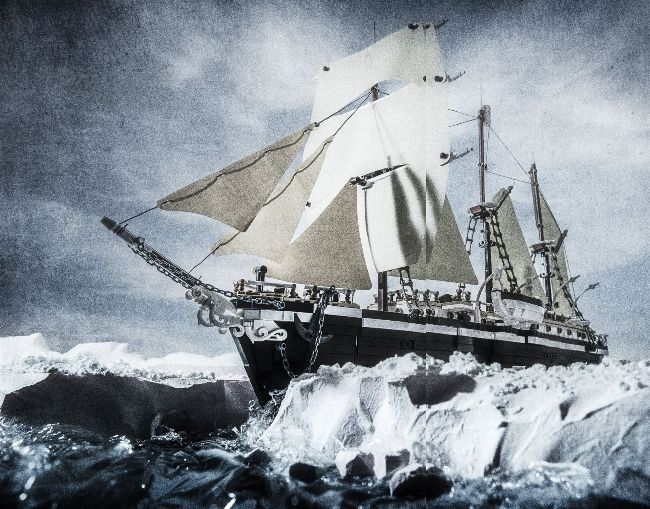
The Endurance arrives at the frozen Weddell Sea. At this point, Shackleton thinks they can reach the shore.
Use your tips cards
This project features in this month’s bonus tips cards. For a handy guide to capturing photos like this, take your tips cards with you.
1 | CREATIVE
Photographing history with Lego bricks
Professional toy photographer Benedek Lampert recreates the ill-fated Endurance expedition
Sir Ernest Shackleton and his ship, the Endurance, make a captivating story. In 1915, his planned expedition to Antarctica ran into the ice of the Weddell Sea and, despite minimal chances of survival, Shackleton and his crew managed to escape its grip. Their perseverance and struggle remain an inspiration to this day and this is what captured my attention and motivated me to create a photo series in tribute.
Since this is a true story, I needed to think in terms of a series, as one image wouldn’t suffice. It was also important to preserve the atmosphere and make the images resemble the original archival photos as closely as possible, which I kept in mind during post-production. I also paid attention to real moments in the story, such as when the crew played football on the ice.
The challenge in toy photography is that you need to analyse what makes reality appear real. What is usually natural must be simulated, so I used lighting to create the feeling that the viewer was on an endless ice field. For the series, I used a Nikon D750 camera body with a Nikkor 24-70mm f/2.8 lens and a Laowa 15mm wide macro lens. www.figsfanphotos.com
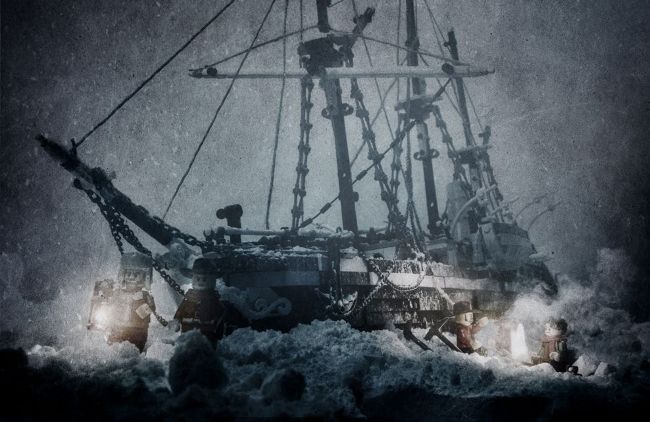
The ship is trapped and the crew tries to keep warm.
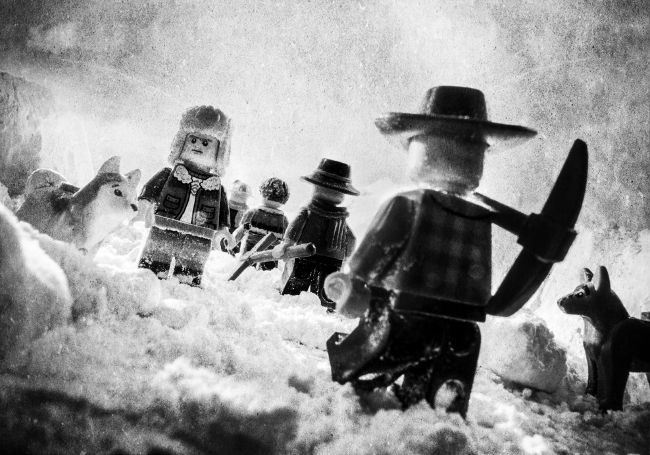
Shackleton and his men set off on a desperate journey across the ice.
Benedek Lampert
Shooting the scene
1
Creating the ice and ocean
Simulating water is challenging and real water isn’t always the best solution. Here, I used cellophane to represent the water, powdered sugar for the icy surface and an XPS foam board for the huge icebergs. Lighting is a key factor so I used a strong flashlight as the sun.
2
Real fire and lantern light
In my photos, it is important to try creating some effects for real without fake elements. After I put some sugar on the ship with the brush, I ignited some matches as a campfire, and used small LEDs for the lantern. After this, I blew smoke over the scene to create some haze.
3
Wide macro perspective
Even though the ship is not in the picture (after it sank) it is still meaningful as the real survival challenge had just begun. I also wanted to make a memorial for the dogs who died for the crew. This time, I used a Laowa wide macro lens and tried a Dutch tilt for more intense dynamism.
Figure positioning and emotions
Toy photography is not just about capturing a product shot with well-arranged lighting. Emotions and movements are just as important as when photographing real people. Mini-figures make great actors because they allow us to use a wide range of facial expressions. In this shot, which captures the crew passing time by playing football, this is the most important element.
I even had to slightly adjust one figure’s arm to create a more lifelike movement. This way, the storytelling element becomes clearer and the entire image feels much more alive.
Using creative overlays
With some authentic black and white archaic overlays, you can make the viewer feel as though they were actually there, so they can almost feel the history itself. Also, this is a great tool to mask that the model is made of Lego. Typically, I use only one overlay but here, I combined three of them using a simple masking technique.
2 | ACTION
Get into the swing of it
Wendy Evans is your caddy for a selection of golfing action shots
Golf is a sport that can be played by anyone, regardless of experience G or talent, with courses around the country to suit all levels. So whether you’re practising your photographic techniques with a golfing friend or covering your local amateur tournament, there are several different styles you can employ. On the one hand, there are action shots, recording the swings and putts, for which you will need a short telephoto, and then there are also portrait-style shots, which can be taken with anything from 35-100mm focal lengths. So let’s have a look at how to capture four different types of shot.