ESCAPC VELOCITY
How the creators of Journey To The Savage Planet emerged from Stadia’s rubble to start again
By Julian Benson
Game
Revenge Of The Savage Planet
Developer/publisher Raccoon Logic
Format PC, PS5, Xbox Series
Release 2025

Reid Schneider, studio head
On February 1, 2021, Raccoon Logic studio head Reid Schneider was on the side of a mountain snowboarding with his son when he got a phone call from the office. “Where the fuck are you?” the caller asked, interrupting what was supposed to be a celebration – his team at Typhoon Studios had just shipped the colourful sci-fi shooter Journey To The Savage Planet on Google Stadia, the first game for the corporation’s cloud-streaming tech that came from an in-house team.
Google was demanding a meeting, the caller told him. “Whenever they say you have to come, you’re like, ‘Oh, it’s one of those’,” creative director Alex Hutchinson says. “This is not a good day.”Google had decided to shut down its Stadia Games And Entertainment division, the in-house group formed to develop games and technology for its proprietary cloud-streaming platform, and it was making all the employees redundant. This included the entire Typhoon Studios team, which Google had acquired in December 2019 to staff its new Montreal offices, barely over a year previously. “We were the first, last and only Google game ever,” Hutchinson says, “and they made us redundant on the day we shipped it.”
Today, as we sit in the offices of Raccoon Logic, the new studio formed from the rubble of Typhoon Studios – again in Montreal – waiting for the demonstration build of Revenge Of The Savage Planet to load, a battled-for sequel that shouldn’t exist, Schneider tells us the team “took just a little bit of inspiration” from their experiences at Google.
“All of us
here at head office could not be more excited to welcomeyou into the Alta family, and we look forward to supporting you in your adventures. Onward and upward,” says Eva Pedantica, VP of Alta Interglobal, in Revenge Of The Savage Planet’s introductory video. As in the first game, key narrative moments are delivered in charmingly hammy live-action cinematics. “Strangely, it’s still cheaper to hire actors and build props on a set than to do it in-game these days, which I find mildly horrific,” Hutchinson says. The smiling executive tells you that Alta has just acquired your employer, Kindred Aerospace, folding it – and your employment contract – into its operations.
“WE WERE THE FIRST, L AST AND ONLY GOOGLE GA ME EVER. AND THEY MADE US REDUNDANT ON THE DAY WE SHIPPED IT”
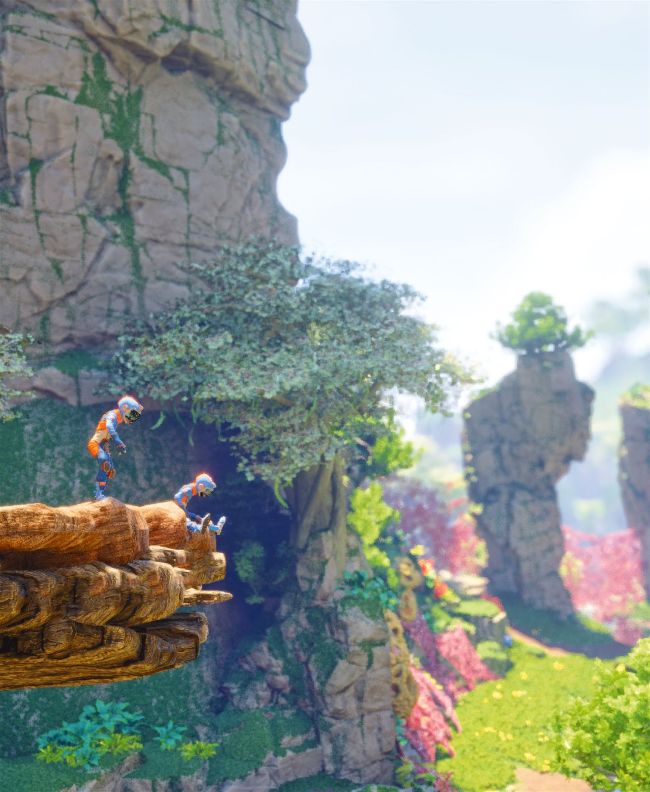
Savage Planet supports both local and online co-op, an essential feature for collaborative humour. As Hutchinson says, “A one-liner is funny once, but kicking Reid off a cliff is funny forever”
Alta, “the world’s largest corporation”, is starting a bold new venture in deep-space colonisation, Pedantica explains, and you are lucky enough to be in its first wave of colonists. While the company would “love” to use its advanced teleportation technology to send you instantly to your assigned planet, Pedantica says that it currently has a few problems with organic material – demonstrating the point by showing its explosive effect on a cat. (“We changed the blood to green,” Hutchinson notes. “Now we can ship the game in Germany.”) Rather than teleporting, you’ll have to take the long route to the jungle planet Stellaris Prime by spaceship, passing the 100-year journey in cryosleep.
Your new employer may be the “largest and most successful holding company in the universe”, but in practise it proves to be no more adept at space travel than previous outfit Kindred Aerospace was in the first game. As in the original, you arrive at your destination like a burning comet, crashing to the planet’s surface wreathed in flame and with most of your equipment scattered or destroyed.