THE MINTER'S TALE
Inside Digital Eclipse’s captivating chronicle of the early years of Llamasoft
By Chris Schilling
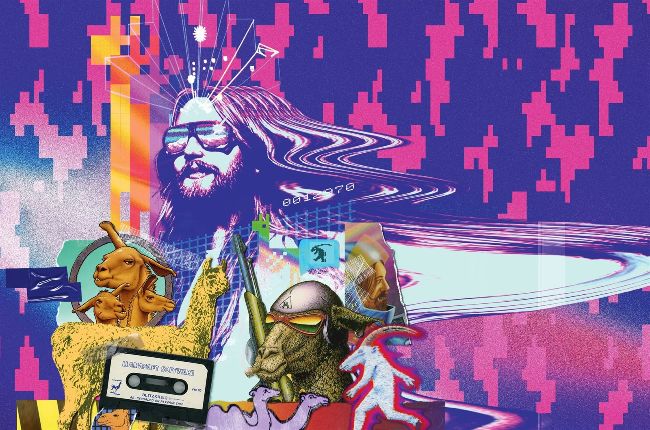
Game Llamasoft: The Jeff Minter Story Developer/publisher Digital Eclipse Format PC, consoles TBA Release Q1 2024
Mike Mika first met Jeff Minter at CES in Chicago in 1994. He has pictorial proof, gesturing over Zoom to a photo on the wall behind him, marking what was clearly a significant moment in the life of Digital Eclipse’s studio head.
Having grown up with a Commodore 64, with Minter’s Gridrunner proving a formative gaming experience, Mika was initially too scared to talk to his hero. He needn’t have worried. “It turns out he’s one of the nicest guys on the planet,” he recalls. As both a fan and a budding developer, Mika says the encounter set certain expectations as he sought a way into the industry. “It was like: hey, if everybody’s like Jeff, this is gonna be a great place to be.” He breaks into a broad grin. “Turns out nobody’s like Jeff.”

Chris Kohler, editorial director, Digital Eclipse

Minter was inspired to make light synthesiser Psychedelia shortly after a two-week tour of Peru
Llamasoft: The Jeff Minter Story, the second entry in Digital Eclipse’s Gold Master Series, combines the intimacy of its predecessor, The Making Of Karateka, with the scope of the widely acclaimed Atari 50: The Anniversary Celebration. Among the package’s many accomplishments, it proves the veracity of Mika’s assertion – there really is no one quite like Jeff Minter – and effectively repays the kindness its subject showed him 30 years prior. The two have kept in touch, on and off, ever since, Digital Eclipse editorial director Chris Kohler tells us. “They’ve basically been trying to find something cool to do together. And this was it.”
Of course, this is more than just a matter of belatedly returning a favour. What made Project Alpaca (as it was known internally) so appealing for Digital Eclipse was a sense that, for many – especially outside of the UK, Minter’s home for most of his life – this is something of an untold story. Or at least a comparatively little-known one. The interactive timeline spans 13 years of Llamasoft – from 1981’s 3D3D (coded in BASIC for Sinclair’s ZX81) to 1994’s Tempest 2000. The latter, Kohler says, marks a natural endpoint. Not just because that’s “the last game that we could emulate”, but because “it’s considered Jeff’s masterpiece”, the Atari Jaguar killer app bringing global attention to the man affectionately known as Yak.
There’s a sense, too, that Digital Eclipse felt it had a point to prove. Kohler, a regular guest on podcasts such as Retronauts, notes that US perspectives colour how older games are discussed throughout media and culture. “We always get that sort of feedback from UK listeners: ‘What you guys are talking about doesn’t represent what I grew up playing’. It’s like, ‘You should talk more about Dizzy!’” he laughs. “We’ve been accused of this,” Mika adds. “Not focusing enough on an entire history of game production and contribution from, especially, the UK game scene.”
Minter made for an ideal entry point, since his story is naturally informed by developments in the UK industry at the time – from the relatively late-breaking influence of consoles to the rise of shareware. “Jeff is one of the progenitors of that whole mythos: he was the bedroom coder,” Mika says. “And the shame of it all is that, in the US, most people who didn’t grow up with a Commodore 64 have no idea how much of an impact that scene had on the game industry – from Sony PlayStation to everything beyond. There’s a throughline from modern games to so many of those development houses.”