COLLECTED WORKS ED ROTBERG
Meet a man from the forefront of gaming’s momentous leap into 3D
By Paul Drury
BATTLEZONE
Developer/manufacturer Atari Format Arcade Release 1980
BRADLEY TRAINER
Developer/manufacturer Atari Format Bespoke Release 1981
SNAKE PIT
Developer/manufacturer Sente Format Arcade Release 1984
BLASTEROIDS
Developer/manufacturer Atari Games Format Arcade Release 1987
S.T.U.N. RUNNER
Developer/manufacturer Atari Games Format Arcade Release 1989
STEEL TALONS
Developer/manufacturer Atari Games Format Arcade Release 1991
WORLD CHAMPIONSHIP RACING
Developer/publisher 3DO Format 3DO M2 Created 1997 (unreleased)
Designer and programmer Ed Rotberg has some wise words for those planning a career in videogame development. “Panic early and often,” he suggests. “That was always my mantra, and it’s why most of my games were delivered on time and within budget.”
The philosophy served him well during his four decades of making games. Rotberg joined Atari in January of 1979 and began work on Baseball, a mod kit for the successful Atari Football cabinet, which featured a very early example of speech synthesis in a coin-op, though that particular feature never made it out of the lab. Following ‘Theurer’s Law’ – named after Missile Command and Tempest creator, Dave Theurer, which states that any coder’s first game will not be a hit – Baseball failed to score a home run, but Rotberg was still having a ball. “It was like I’d died and gone to heaven,” he smiles. “I’d always goofed around on the computers at my old jobs, making little games, and now I was being paid to do it.”
His second production, Battlezone, would more than justify Atari’s faith in him, selling over 15,000 units and becoming one of the company’s most acclaimed titles. But Rotberg was not alone in noticing the discrepancy between the vast revenues arcade games were attracting and the comparatively modest remuneration received by their creators, and in 1982 founded Videa with fellow former Atari employees Howard Delman (now Wendy Smith) and Roger Hector. The company was later acquired by Sente (Atari founder Nolan Bushnell’s follow-up arcade venture), which in turn was bought by Bally when Bushnell’s Pizza Time Theater empire ran out of dough.
Rotberg returned to Atari for another successful stint and stayed in videogames and technology through companies such as 3DO, Apple and Innovative Leisure.
Now retired, he still hangs out with many of his Atari friends, hosting an annual golf tournament that reunites some of the old gang. He is also an outspoken pacifist, which makes us wonder if he appreciates the irony that his best-known work is set in a warzone. “I guess I do, but you were just blowing up tanks,” he shrugs.
“I WANTED TO CALL IT DREADNOUGHT, NOT BATTLEZONE. HEY, I DIDN’T SAY I WAS ALWAYS RIGHT”
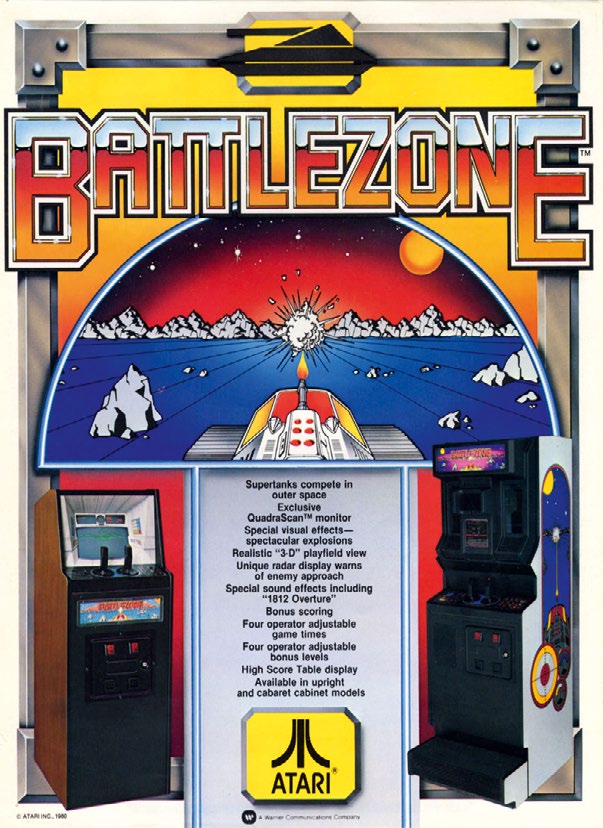
Emulations such as this (top) can’t quite communicate the piercingly crisp visuals provided by Battlezone’s vector display, which helped it to stand out in 1980