Exhibitions
CHARLOTTE JOHANNESSON
Nottingham Contemporary 11 February – 7 May 2023
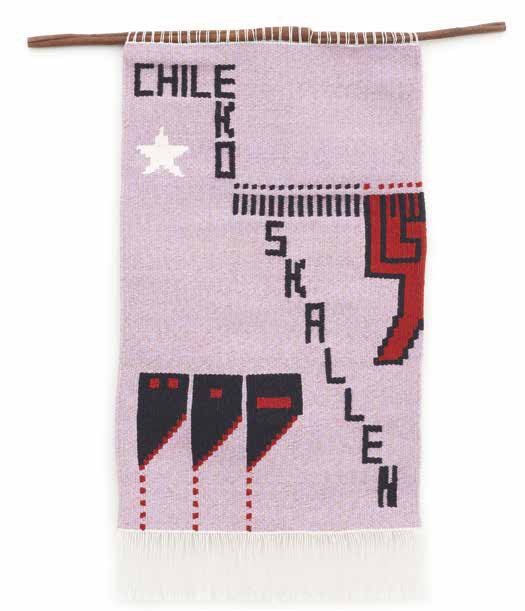
Top left: Charlotte Johannesson: Chile eko i skallen (1973/2016) 108cm x 59 cm, wool, handwoven by TiyokoTomikawa (remake), cinnamon stick
PHOTO: ANDY KEATE
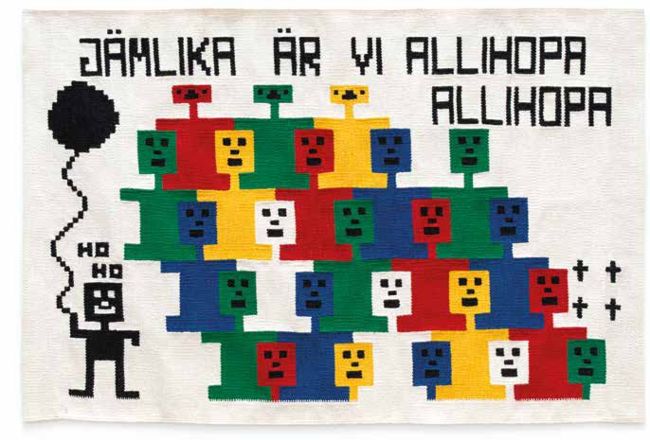
Top right: Charlotte Johannesson: Jämlika är vi allihopa (We are all equal) (1970s-2020), 85.5 x 128.5 cm, wool, handwoven byTiyokoTomikawa, wood, barbed wire (remake)
PHOTO: MICHAL BRZEZINSKI
■ INITIALLY TRAINED AS A weaver during the 1960s, Charlotte Johannesson (b.1943, Malmö, Sweden) began her career making experimental woven artworks that aimed to question the social and political circumstances of the time. In 1978 she swapped one of her woven pieces for an early Apple computer at a time when neither textiles nor digital technologies were taken seriously within mainstream art circles. Johannesson found parallels between traditional craft and textile processes and computer coding in relation to scale and proportions, and the labour-intensive processes required for both. She noted: ‘There was a great synchronicity between the two machines, which I thought I could use: on the computer there were 239 pixels on the horizontal side and 191 pixels on the vertical side, and that was exactly what I had in the loom when I was weaving.’ Johannesson’s solo exhibition at Nottingham Contemporary hosts over 70 works and charts the development of her research, skills and international artistic career to the present day. The scope of inspiration and range of materials Johannesson has used is striking. Her wider work incorporates everything from icons of popular culture such as Mickey Mouse, to powerful text slogans, working with materials including hemp, linen, wool and leather enhanced with buttons, pins, needles and pencil sharpeners. Many of the pieces in the exhibition are overtly political or feminist, while others offer philosophical nods toward the history of art and music icons, specifically in the digitally woven wool works Apple, which pays homage to Surrealist artist René Magritte (and computer technology), and David Bowie (both 2019). Alongside colourful pieces plotted and printed on paper and three large freestanding computer graphic slideshows made between 1981 and 1985 in a darkened, dedicated room, the exhibition contains additional smallscale works made especially for this presentation. Her delicate hand-woven lace pieces, for instance, Umbrella and Braincell (both 2022-2023) overtly reference the textile manufacturing heritage of Nottingham as a renowned centre for lace production. One piece even incorporates a small, distinctive depiction of Robin Hood. Several works made from handmade paper also feature, showcasing Johannesson’s continuing experimental approach to materials and skills across multiple making methods. Works hung against white walls or suspended from the ceiling are accompanied by display cases which hold archival photographs of the artist at work and carefully shaded, handsketched plans for artworks made on squared paper. Johannesson’s breadth of approach across her career of over 50 years is further emphasised by differences in scale, from a large window-based installation made from 3D prints and three immersive screens, to tiny, detailed drawings and textiles. In 1985 Johannesson stopped making digital works of art and returned to weaving. A subsequent collaboration with Danish graphic designer Louise Sidenius saw some of Johannesson’s early digital drawings made into woven digital graphics, some of which are on display in the exhibition’s first room, hung in a grouped formation. Here, the weaving becomes digital and is then woven again. The exhibition, and Johannesson’s practice, loops back on itself.