Disarming charm
RICHARD SAJA PLAYS WITH THE BUCOLIC PASTORAL SCENES OF 18TH AND 19TH CENTURY TOILE DE JOUY TO DISARMING EFFECT, BUT HIS WORK IS ROOTED IN A DEEP UNDERSTANDING OF HISTORY
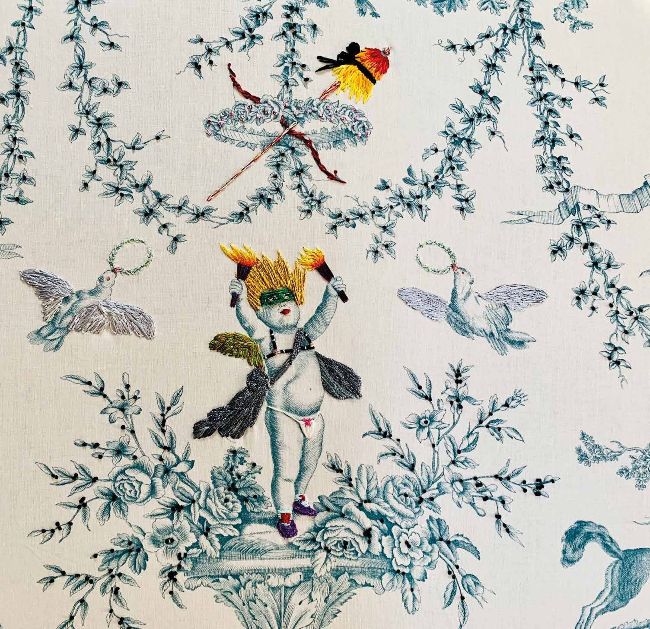
Left: Queer (2022), 20cm x 25cm, rayon floss, cotton, referencing Columbia from The Rocky Horror Picture Show and the seemingly ubiquitous/ridiculous ‘fashion harness’. Made for an exhibition exploring shoes in Koln
■ EVEN THOSE OF US WHO wouldn’t call themselves history buffs probably realise punk never did meet pastoral in 18th and 19th centuries decorative arts, hence the name of Richard Saja’s business: Historically Inaccurate Decorative Arts. Richard, himself, is a little bit impish and, one feels, ready to run riot with his surface embellishment of traditional French toile de jouy fabrics. The embroidered blue star covering a Venus-like figure’s nipple or the crazy colourful punk hair added to a courting couple in the bucolic countryside; the cherub holding two blazing torches and sporting more punk hair; the nymph with a blindfold; it all effervesces from Richard’s ripe imagination and is stitched by him in his Hudson Valley home, dating from 1865, in the USA.
When Richard tells me he will be having a solo show at the Musée de la Toile de Jouy in Jouy-en-Josas, I wonder if he realises what he’s letting himself in for. The disapprobation of the French in the very commune where toile de jouy originated – the phrase translates literally as ‘cloth from Jouy-en-Josas’ – could be difficult to deal with. But Richard is an old hand. He’s been working with toile de jouy for two decades and has already been part of a group show in Jouy-en-Josas, held in 2015 to commemorate the 200th anniversary of the death of Christophe Phillippe Oberkampf, the principal maker of toile de jouy fabric. In the 1600s, chintzes were imported from India to France and were so wildly popular that the government banned them because of the effect it was having on their own producers. The ban was lifted in 1759, with Oberkampf setting up a factory and becoming the largest printer of cotton fabrics in Europe.