DIFFERENT BEAT
HAVING SPENT YEARS ENSCONCED IN HORROR, DIRECTOR MIKE FLANAGAN MINES SWEETER MATERIAL WITH EXISTENTIAL COSMIC DRAMA THE LIFE OF CHUCK. WE JOIN HIM AND STAR TOM HIDDLESTON TO TALK LIFE, DEATH AND DANCING
WORDS AL HORNER
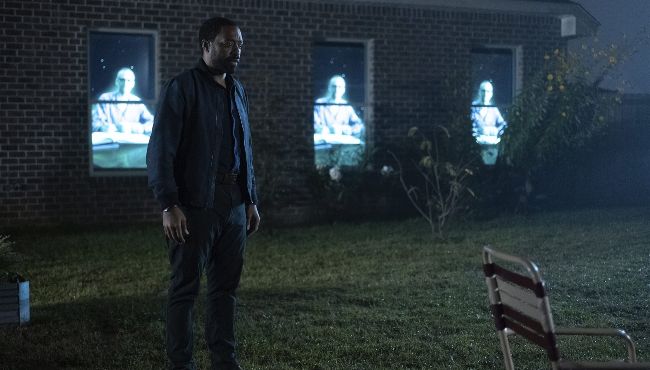
Clockwise from main: Haunted divorcé Marty (Chiwetel Ejiofor);
Mike Flanagan knows the word “feel-good” isn’t often associated with the apocalypse. Nor, to be honest, with his work as one of the era’s premier fright-masters; a writer-director whose oeuvre has so far included vampire priests (Midnight Mass), acid showers (The Fall Of The House Of Usher) and some of the most brutal small-screen deaths of all time (The Haunting Of Hill House).
It’s not how you’d typically describe the icon of literary terror he’s becoming closely associated with, either. Flanagan’s latest film, The Life Of Chuck, adapted from a 2010 Stephen King novella, is the third time he’s brought the legendary author’s words to the screen, after Gerald’s Game and Doctor Sleep, with new adaptations of Carrie and The Dark Tower also on the way.
But The Life Of Chuck is, nonetheless, as feel-good as apocalypse stories come. A meditative, non-linear, cosmic drama, it stars Tom Hiddleston as Chuck Krantz — a seemingly ordinary man who mysteriously begins appearing on billboards as divorced couple Felicia (Karen Gillan) and Marty’s (Chiwetel Ejiofor) leafy suburban existence is interrupted by a series of globe-threatening disasters. The mystery of “Who is Chuck?” propels a story more still and sentimental than many viewers might expect from Flanagan, from King, from the end of the world.
“It’s a film about life in consideration of death. Because consideration of death inspires appreciation of life,” says Hiddleston, who embodies that with a major scene involving the most elaborate dance sequence this side of Sinners’ juke-joint blow-out. He and Flanagan sat down with Empire to discuss hope, grief, and why the most surprisingly life-affirming film of the year might owe it all to Alan Carr: Chatty Man…
You’ve each described crying the first time you read this story. What was it that hit you both so profoundly?
Mike Flanagan: Where the world was at the time, reading the novella in April 2020 at the start of the pandemic had a very uncomfortable overlap with the beginning of the story. I very much felt like the world was ending outside the window, and that there was no way to know how we would get back from where we seemed to be going. There was a lot of anxiety and a lot of dread at the time that made the story very difficult for me to read, initially. But by the time I got to the end, what made me cry wasn’t the despair or the anxiety — it was its overwhelming sense of optimism and joy and hope. That’s what really resonated with me. The idea that I could have been so unexpectedly lifted up from that place that I was in when I sat down to read it… there are very few stories I’ve ever come across in my life that have had that power. Tom, I don’t know about you…?