BRAKING – THE LAW
Bike brakes have come on massively in the last few decades. Here is our guide to the state of the art, and how you can get the best from your stoppers.
WORDS: ALAN DOWDS IMAGES: FB ARCHIVE
TECH
Whaddya need brakes for? They only slow you down! It’s a daft joke and, of course, it’s way off the mark. Better brakes will make your bike faster – the quicker you can decelerate on the way into a corner, the more time you can spend at top speed before braking, and the later you can get onto the stoppers into a bend.
But away from the track there are very obvious benefits to good brakes too, in terms of ‘not dying’ every time some (insert expletive) nutter pulls out on you in a car.
And it’s also fair to say that a really good, strong, controllable set of brakes is one of the great pleasures in performance riding. When you’re really on song at a trackday, right in the groove, and you make the near-perfect braking move at the end of a big straight, thesheer violence of the forces involved, and thefine line you’re treading between fun and disaster, can be utterly exhilarating.
The good old days
Back in the very early days of bike design there wasn’t much of that around. Brakes were very much an afterthought – and on the earliest bikes (essentially push-bikes withesmall bolt-on motors) you stopped witheyour feet. Even when motorbike design moved on from its bicycle foundations, there often wasn’t any front brake at all, withepre-war riders often relying on back brakes.
And when we say ‘brakes’ we mean it in the loosest sense – you were likely to be relying on a bit of flat metal pushing onto the top of the tyre (a ‘spoon brake’ ffs), or a leather strap tightened around a drum on the wheel.
That’s not as big a problem as it might sound actually, since they only had about a quarter of a horsepower, and they broke down every 100 yards anyway. But, as engines got more powerful and chassis designs started to become more sophisticated, the need for a better brake solution grew. And that next tech step was drum brakes. Similar in concept to the old ‘band brakes’, you now had the friction materials bonded onto curved ‘shoes’ inside a hollow hub. Levers operated by Bowden cables pushed these shoes out onto the inner face of the hub (or drum), and the friction material slowed the wheels down. Simple, basic stuff, and enough to keep bikers happy right up until the late 1960s.
By then, the very best drum brake designs used large diameter hubs, withemultiple shoes. And they gave strong, powerful stopping power. What they still couldn’t do though, was cool themselves down adequately, even withecunning vents and ribbed outer hubs. As the friction material overheated, it lost its efficiency and the braking force faded away. The heat also distorted the drums themselves. Something needed to change.
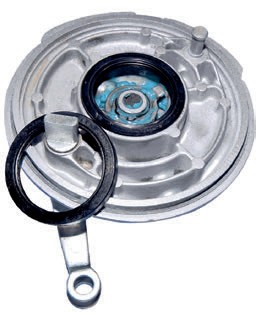
From leather straps to shoes, braking has come on a long way over the last century.
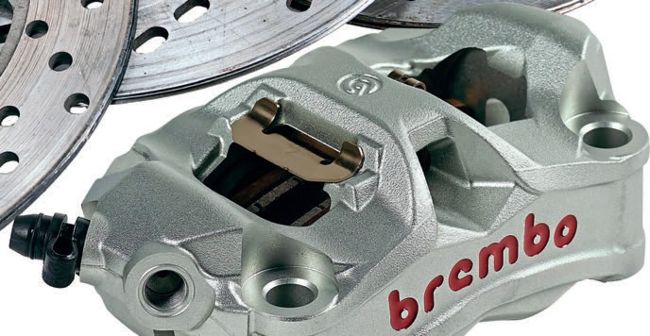
More than just bling, hi-spec monoblocs (like these Brembo Stylema calipers) offer awesome stopping power.