Killing Caesar
The story behind Rome’s most infamous assassination
Words: Adrian Goldsworthy
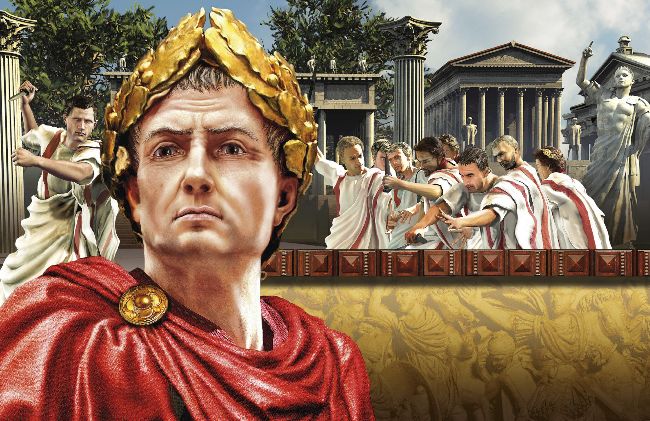
MURDER MOST FOUL The killing of Julius Caesar by his political rivals remains a fascinating chapter in the rich story of Ancient Rome
ILLUSTRATION: © KURT MILLER/SALZMANART.COM, ALAMY X1
“Et tu Brute? Ten fall Caesar!” Julius Caesar utters these final words less than halfway through Shakespeare’s play which, in spite of its name, is more concerned with the tragic hero, Brutus. Te playwright was confident that he did not need to translate the three Latin words; even today, this is one of a handful of Latin phrases most people know.
The scene, where the greatest and most powerful man in Rome is repeatedly stabbed during a meeting of the Senate – killed by conspirators whose leader likes Caesar personally but feels that he must die for the good of the state – is both spectacular and dramatic. Over the centuries it has been depicted countless times in art, on stage, in print and on screen, the latter both seriously (by Rex Harrison in Cleopatra) or parodied by Kenneth Williams in Carry On Cleo. It is just the sort of over-the-top death Hollywood loves to invent - much like in Gladiator where the Emperor Commodus is killed in the arena of the Colosseum rather than being strangled in the bath.
Yet, in Caesar’s case, there was no need for artistic licence. He was murdered at the height of his power, in the Senate, stabbed 23 times by conspirators armed with daggers. Many of them, including Brutus, were former friends, but they killed him anyway, and claimed that they were restoring liberty to Rome. If anything, the truth is even more complicated, filled with irony and intrigue, at times coming across as the plot of a soap opera.
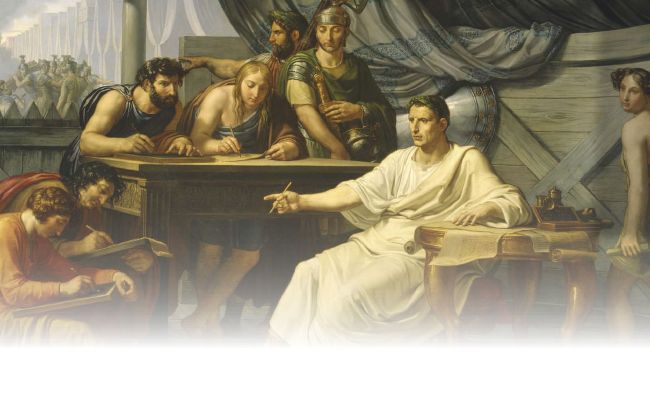
WISE WORDS: Caesar dictates his commentaries on the Gallic and civil wars
FIRST-HAND ACCOUNT
Caesar’s books, which describe his military successes, are lauded for their clear and direct use of Latin and are still studied today.
MURDER IN MIND
Caesar was murdered on 15 March - the Ides of March as the Romans called it - in the year that we know as 44 BC. Te city of Rome was some seven centuries old and, since 509 BC when the last king was expelled, had been a republic. Te conspirators who murdered Caesar claimed that his power had brought the Republic to an end and that his death was necessary to restore it.
The central principle of Republican Rome was that no one individual or group should possess permanent supreme power. To this end, the Romans developed a complex system of checks and balances, even though, like Britain, they had no written constitution, but a patchwork of laws and precedents. The people - or, at least, male Roman citizens able to be in Rome to vote - elected all magistrates and voted on the laws brought before the popular assemblies. Te Senate consisted of some 600 men drawn from former magistrates and was a permanent council, but had no formal powers and was merely a debating and advisory body.
The most important magistrates were the two consuls who held office for just 12 months. No-one was allowed to stand for re-election until ten years had passed. Given that the minimum age to stand for the consulship was 42, this effectively meant that it was very rare for anyone to be consul twice, let alone three times. During their year of office, the consuls had considerable power, but neither one could overrule his colleague.
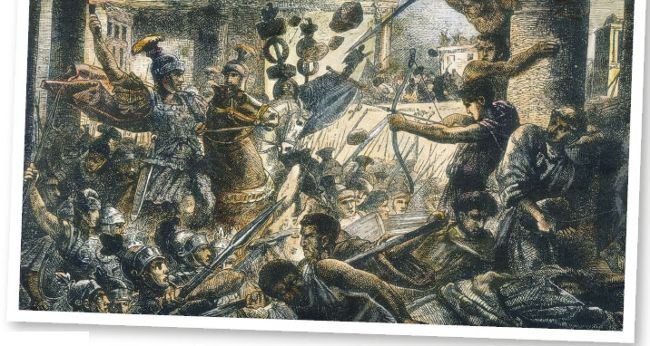
Sulla attacking Rome en route to becoming dictator
For a long time, the system kept Rome free of the frequent revolutions that beset most ancient states, especially in the Greek world. Competition for the consulship was fierce. With 600 senators, it was impossible for more than a minority to become consuls; plus, a handful of aristocratic families dominated the office. Tey had reputation and the money to advertise their achievements and to buy voters, helped by the Roman fondness for electing people with names they were familiar with.
The conspirators believed the murder was necessary to restore the Republic
BENDING THE RULES
Rome had come to dominate the Mediterranean world by the middle of the second century BC, but the system was showing signs of strain. It now had an empire stretching from Spain to Macedonia, and many problems - especially wars in distant lands - could not be resolved in just one year under the leadership of one consul. Te rules began to be bent or broken. In 104-100 BC, Marius, Caesar’s uncle by marriage, held five successive consulships; he was the only general trusted by voters to deal with the threat to Rome posed by large groups of Germanic migrants who had already massacred several Roman armies.