How Did They do That?
Indonesia's ancient temple is a cosmic journey in stone...
JH
THE BUDDHIST STUPA
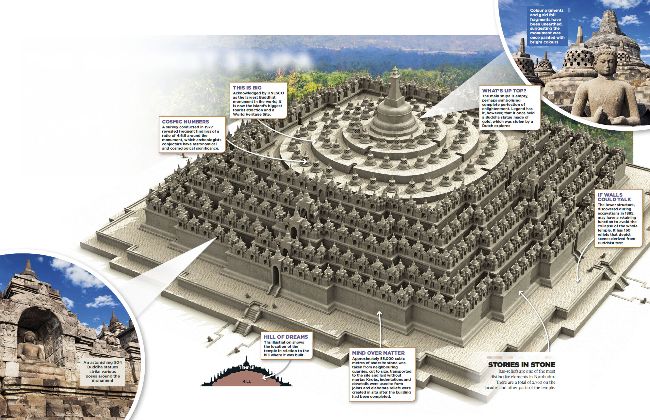
ILLUSTRATION: SOL 90 IMAGES, GETTY X
STACKED
Borobudur was built on a hill and has a pyramidal structure with nine platforms: the lower six are square and the three above are circular.
Burial mounds containing relics date back to Neolithic times. Tey were also common during the lifetime of the Buddha and he instructed his disciples to erect them at crossroads to commemorate great sages and heroes. After the Buddha's death, a monument (known as a stupa) was to be raised in his honour. Te legend says that eight of the mightiest princes fought for his ashes and bones. Tese relics were distributed to eight different kingdoms, and stupas were erected over them. Most well- known is the Borobudur Temple Compounds on the isle of Java.
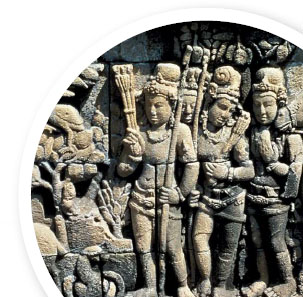
A bas-relief showing scenes from Buddha's life (circa 750-850).
BOROBUDUR TEMPLE COMPOUNDS
Borobudur was built in the 8th and 9th centuries. It was used as a Buddhist temple until sometime between the 10th and 15th centuries, when it was abandoned. Hidden for hundreds of years under layers of volcanic ash and jungle growth, it was rediscovered in the 19th century and restored in the 20th. A stupa is intended to portray the path to enlightenment. Pilgrims begin at the base, follow a path around – purifying negative karma as they go – and then ascend through three levels symbolic of Buddhist cosmology: Kamadhatu (the world of desire), Rupadhatu (the world of forms) and Arupadhatu (the world of formlessness) to the central stupa and Nirvana.