SPOOKY SPACE PHENOMENA
How It Works ventures beyond Earth to discover the creepiest celestial objects in the cosmos
Words by Ailsa Harvey and Laura Mears
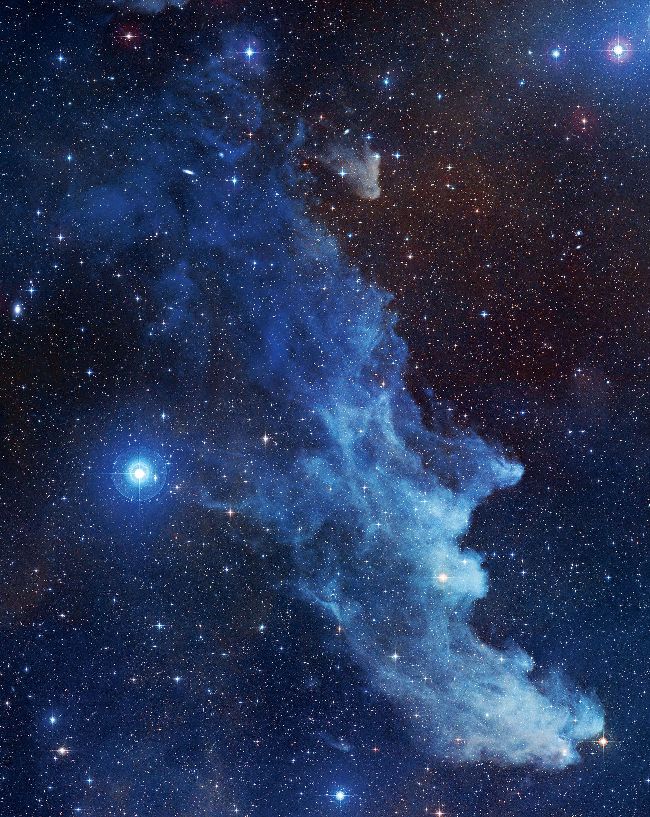
The nebula forms the shape of a witch’s side profile, seen looking to the right here
© NASA/STScI Digitized Sky Survey/Noel Carboni
Orion’s witch
This wispy outline, with its hooked nose and curved chin, bears a striking resemblance to the profile of a traditional fairy-tale villain. It is known as the Witch Head Nebula.
The Witch Head Nebula - officially IC 2118 - is a reflection nebula, so it does not produce any light of its own. It is found in the constellation of Orion, west of the blue supergiant star Rigel. Rigel is one of the brightest objects in the night sky, between 40,000 and 100,000 times more luminous than the Sun.
Even though it lies over 40 light years from the nebula, the blue light that Rigel pours out into space illuminates the spooky silhouette of the Witch Head Nebula. It doesn’t provide enough energy to ionise the gas and make it glow, but the light scatters as it passes through.
The dust that comprises the nebula scatters blue light more easily than it scatters red, so Rigel’s blue shade is intensified. This is the same physical phenomenon that makes Earth’s sky appear blue - Rayleigh scattering.
Face on Mars
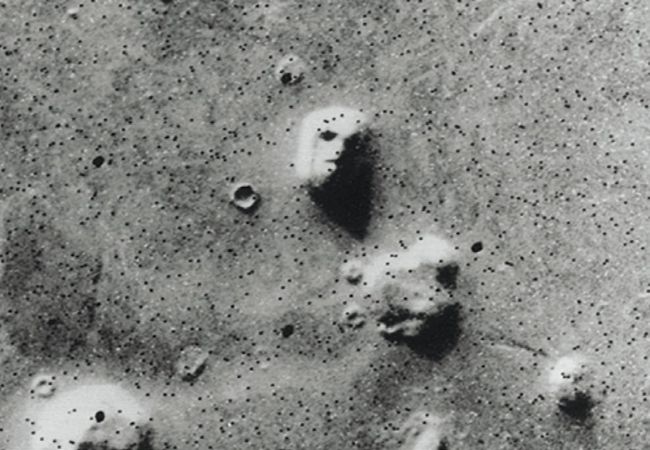
Can you spot the face just above the image’s centre?
© The Viking Project, NASA
Will we find signs of life on Mars? It’s a question many have asked before, but when the Viking 1 mission beamed back this picture of the planet’s surface, it showed potential signs of life that were a bit too close to home. Eerily emerging from the rocky surface of the Cydonia region is a human face, wearing a stern expression.