GB
  
You are currently viewing the United Kingdom version of the site.
Would you like to switch to your local site?
6 MIN READ TIME

MOTORBIKE EVOLUTION

From simple early designs to today’s speedy sporting tech, these two-wheeled vehicles have stepped up a gear

DID YOU KNOW? By 1920, Harley-Davidson had 2,000 dealers in 67 countries
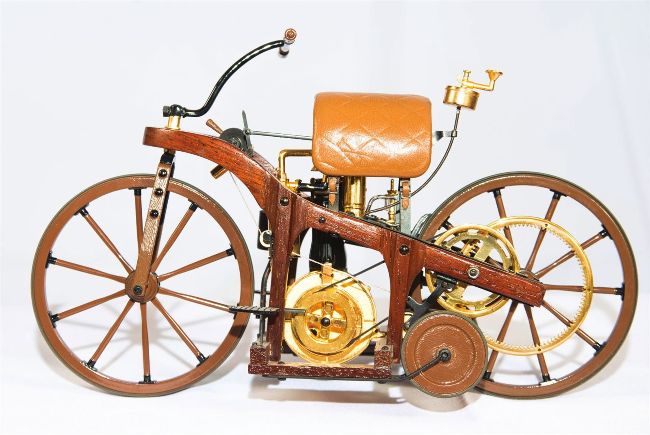
The Reitwagen’s engine produced 0.5 horsepower at 600 revolutions per minute (rpm)

1885: THE FIRST MOTORBIKE

Described as the first true motorbike, the 1885 Daimler Reitwagen was the earliest motorcycle to be successfully powered by a petrol engine. The Reitwagen bike, which means ‘riding wagon’ in German, was engineered by inventors Gottlieb Daimler and Wilhelm Maybach. Daimler is considered to be the ‘father of the motorcycle’ despite three similar models being invented prior to the Reitwagen. This is because they were steam-powered and didn’t fit the definition of a modern motorcycle: a two-wheeled vehicle with an internal combustion engine.

The Reitwagen had a single fourstroke 264cc (cubic centimetre) engine. Its maximum speed of 6.8 miles per hour is nothing compared to today’s superbikes, hitting speeds of over 200 miles per hour. Despite being classed as a motorbike, the two-wheeled Reitwagen required additional small wheels as stabilisers to keep it upright when turning corners. Nevertheless, the low speeds and mobility issues were overlooked for this motorbike’s innovations, and the Reitwagen served as a template for future motorbikes, sparking the evolution of more mobile and efficient models.

Unlock this article and much more with
You can enjoy:
Enjoy this edition in full
Instant access to 600+ titles
Thousands of back issues
No contract or commitment
Try for 99p
SUBSCRIBE NOW
30 day trial, then just £9.99 / month. Cancel anytime. New subscribers only.


Learn more
Pocketmags Plus
Pocketmags Plus

This article is from...


View Issues
How It Works
Issue 180
VIEW IN STORE

Other Articles in this Issue


How it works
WELCOME
Technology news has been buzzing with stories of
REGULARS
Bubble hunting
© Getty Beneath flocking gulls, these humpback whales
Snapping skyscrapers
© Alamy Margaret Bourke-White was an American photojournalist
Fungal handshake
© Alamy This is a scanning electron microscope
Peering behind bars
© ESA/Webb, NASA & CSA, J. Lee and
Perseverance rover finds organic molecules on Mars
N ASA’s Perseverance rover has found a diverse
Swirls of liquid iron may be trapped inside Earth’s core
Earth’s solid inner core may not be solid
SCIENTISTS DISCOVER A HUGE HOT BLOB ON THE MOON
Recent observations of the Moon’s far side revealed
Roman mausoleum discovered in the rubble of a London building site
Excavations revealed elaborate mosaics at the centre of
SCIENTISTS DISCOVER WHERE THE MICROPLASTICS HUMANS INHALE END UP
Researchers estimate that humans inhale a credit card’s
Scientists make the world’s first genetically modified snakes
Introducing the world’s first genetically modified snake ©
Spider kills prey with gruesome tactic
Fuzzy, long-legged spiders may attack their prey with
WORLD’S DEEPEST CANYON IS HOME TO ASIA’S TALLEST TREE
An aerial view showing the giant cypress measuring
Oldest active black hole in the universe discovered
A zoomed-in Webb image taken for the
Mysterious ‘Viking disease’ linked to Neanderthal DNA
Dupuytren’s contracture, often called ‘Viking Disease’, is a
THE ORION SPACECRAFT GETS A HEAT SHIELD FOR ITS MOON MISSION
NASA is making headway in its preparations for
Human impact on Earth’s tilt concerns scientists
Water pumped from aquifers between 1993 and 2010
WISH LIST
WILDLIFE WATCHING GADGETS
Who built the Great Sphinx?
Michael Beattie Most Egyptologists think that the Great Sphinx was built by King Khafre, the builder of the second of the pyramids at Giza, who ruled from around 2558 to 2532 BCE. Some believe the Great Sphinx started out as a statue of a lion, with Khafre’s features added later. This combination of man and beast represents the pharaoh’s super-human power: the sphinx suggested that the king was a god on Earth. It may also have been intended to serve as a guardian of the king’s pyramid.
THE LIBRARY
The latest book releases for curious minds
MAKE A CD GREENHOUSE
Recycle transparent CD cases and watch seeds produce roots and shoots
INBOX Speak your mind
The vision of someone with visual snow is
FAST FACTS
Amazing trivia that will blow your mind
SPECIAL
RISE OF THE AI CHATBOTS
How breakthroughs in artificial intelligence are making everyday chatbots smarter than ever
5 JOBS THAT AI COULD REPLACE
1 TECHNOLOGY Workers like coders and computer programmers
HARDWARE FOR AI
Artificial intelligence makes use of a range of sophisticated modern hardware
COULD AI EVER BE TRULY CONSCIOUS?
Tom McClelland is a lecturer in the department of history and philosophy of science at Cambridge University. He ponders the deeper questions about AI
CHATBOT AI BY NUMBERS
SCIENCE
HOW BLOOD TRANSFUSIONS WORK
Our bodies need blood to deliver oxygen and nutrients and remove waste. How do we receive more when we run dangerously low?
LAB-GROWN MEAT EXPLAINED
Would you eat chicken or beef that’s been grown in a laboratory?
HOW HARDNESS IS MEASURED
This scale helps scientists identify and categorise minerals
DIY POWER
Discover the science and technology behind the power tools in your toolbox
TRANSPORT
HOW A CONSTRUCTION CRANE WORKS
Incredible engineering allows these lofty lifters to hoist hefty materials into the air with ease
DIGGING THE CHANNEL TUNNEL
How one of the world’s longest undersea passages came to be
ENVIRONMENT
HOW LIFE EVOLVES
Discover the biological pathways through time that led to the plants and animals of today
HOW STORM SUPERCELLS FORM
What turns an ordinary storm into a whirling maelstrom?
ANATOMY OF A SUPERVOLCANO
Under the surface of Yellowstone National Park lurks a supervolcano that scientists now know to be twice the size they first thought – should we be worried?
HOW OYSTERS MAKE PEARLS
Meet the jewellerymaking molluscs that turn irritating specks of dirt into stunning stones
HISTORY
HOW ANIMATION WAS INVENTED
Before cinema, moving images were created using clever visual illusions
THE ORIGINS OF WEIGHTS AND MEASURES
Why did much of the world switch from the imperial to the metric system?
SPACE
AMAZING FUTURE SPACE ROBOTS
Discover the versatile space machines that can roll, fly, float and swim, from junk recyclers to station companions
FINDING MOON ROCKS
Why astronauts brought lunar rubble back to Earth
TECHNOLOGY
HOW DOES E-INK WORK?
This technology allows e-readers like Kindles to look and read like the pages of a book
Chat
X
Pocketmags Support