WHAT IS A SWIM BL ADDER?
Rising and sinking through water would be impossible for fish without this inflating organ
WORDS SCOTT DUTFIELD
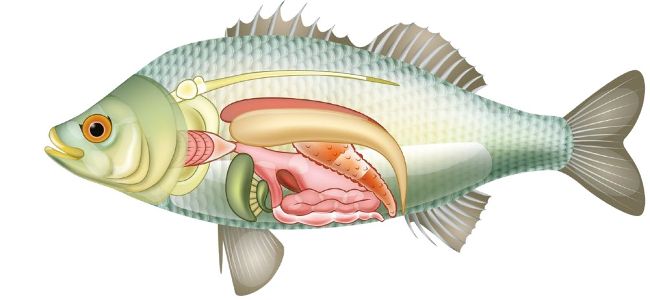
SWIM BLADDER

An open swim bladder taken from a carp
Beneath a fish’s scales is a gas-filled organ called a swim bladder, which has the job of controlling its buoyancy in the water. Swim bladders are filled in one of two ways. Open swim bladders, in fish such as carp and catfish, are filled by gulping in air from above the surface. The air enters the oesophagus via the mouth and then travels through a tube to the swim bladder for inflation. Fish with a closed swim bladder, such as sea bass and rockfish, lack a connection between the swim bladder and the oesophagus and have instead evolved a handy way to get their air. A group of specialised cells attached to the swim bladder, called the gas gland, can diffuse oxygen straight into it. They do this by producing carbon dioxide and dumping it into a nearby web of blood vessels. This causes the pH of the blood to become more acidic, which in turn causes red blood cells to offload oxygen through the gas gland and into the swim bladder.