GLOBAL EYE
Showcasing the incredible world we live in
SPACE
Scientists detect the most powerful cosmic rays ever
WORDS BEN TURNER
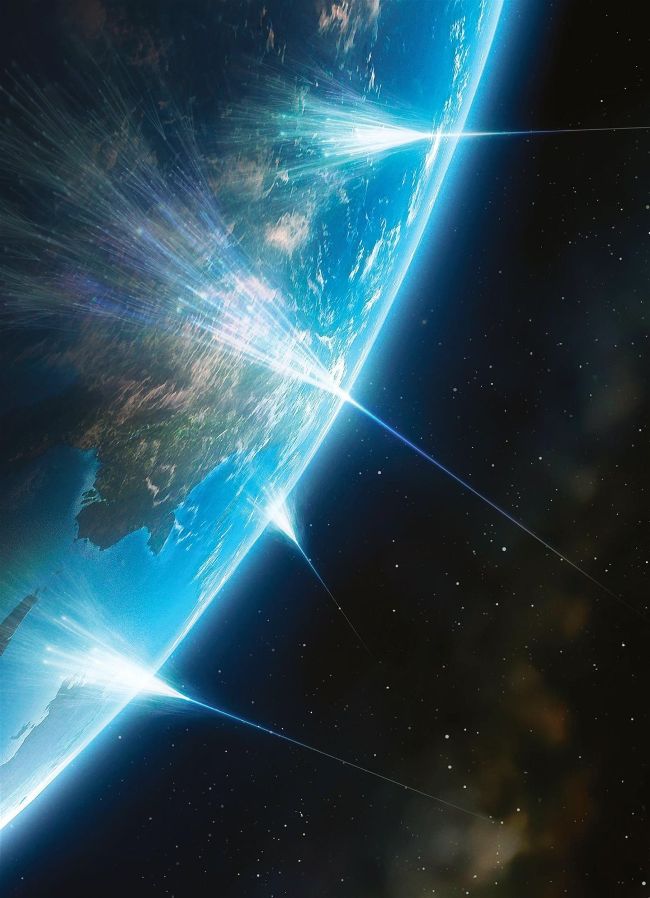
An artist’s illustration of cosmic rays raining down on Earth
Scientists have detected the most energetic cosmic rays
ever discovered, and they’re being produced by mysterious
sources relatively close to Earth. The rays, which consist of electrons and their antimatter counterparts, positrons, were observed at energies all the way up to 40 teraelectronvolts (TeV), or 40,000 times the energy of visible light. Spotted by the High Energy Stereoscopic System (HESS) array in Namibia, the rays lose energy as they travel through space due to their interactions with light and magnetic fields. This means that for rays of this energy to be detected, their sources must be relatively nearby. Yet what exactly is producing them remains unknown.
“This is an important result, as we can conclude that the measured cosmic ray electrons most likely originate from very few sources in the vicinity of our own Solar System, up to a maximum of a few thousand light years away – a very small distance compared to the size of our galaxy,” said
Kathrin Egberts, head of experimental astroparticle physics at the University of Potsdam in Germany. For comparison, our Milky Way galaxy is about 100,000 light years across.
Cosmic rays are high-energy particles produced by the Sun, stellar explosions called supernovae and rapidly spinning neutron stars called pulsars, as well as other unknown sources. When the rays smash into Earth’s upper atmosphere, they break into showers of particles that are detectable on Earth’s surface. But reconstructing the rays that produced these particle showers is a painstaking and uncertain task. To find the cosmic ray electrons, the researchers used the HESS observatory, an array of five 12-metre telescopes in the Khomas Highland Region of Namibia.
Over a decade, the telescopes scanned the upper atmosphere for faint signs of Cherenkov radiation left in the wake of the fast-moving rays. Just as a plane travelling faster than the speed of sound creates a sonic boom, a particle moving through a light-slowing medium faster than light creates a faint blue glow around it. By looking for this glow and using sophisticated algorithms to sift out noise, the scientists created an energy spectrum for the rays hitting Earth in unprecedented detail.
The quantities of these rays decreased drastically at higher energy scales, meaning it will be difficult for smaller space-based detectors to find them in sufficient numbers. Yet the presence of particularly energetic particles gave the scientists a clear indication that at least some of the rays’ sources are close to our planet. “The very low fluxes at larger TeV limit the possibilities of spacebased missions to compete with this measurement,” said Mathieu Jacobé de Naurois, a researcher at the French National Centre for Scientific Research in Paris. “Our measurement does not only provide data in a crucial and previously unexplored energy range, impacting our understanding of the local neighbourhood, but it is also likely to remain a benchmark for the coming years.”
ARTIFICIAL INTELLIGENCE
New technology gives AI the power to feel surfaces
WORDS KEUMAR AFIFI-SABET

Quantum science and machine learning have come together to create a model that can measure how surfaces ‘feel’
Scientists have given artificial intelligence (AI) the capacity to ‘feel’ surfaces for the first time, opening up a new dimension for deploying the technology in the real world. Tapping into quantum science, the scientists combined a photon-firing scanning laser with a new AI model trained to tell the difference between different surfaces imaged with the lasers. The new technology blasts a series of short light pulses at a surface to ‘feel’ it, before back-scattered photons, or particles of light, return carrying speckle noise, a type of flaw that manifests in imagery. This is normally considered detrimental to imaging, but in this case the researchers processed the noise artefacts using AI, which enabled the system to discern the topography of the object. “This is a marriage of AI and quantum,” said Daniel Tafone of New Jersey’s Stevens Institute of Technology.
The team used 31 variations of industrial sandpaper with roughness ranging from 1 to 100 micrometers in thickness, with the thickest roughly the width of a human hair. The researchers then set up the system, which used a laser beam fired in picosecond pulses – 1 trillion picoseconds is one second. Pulses of light passed through transceivers, hit the sandpaper, then rebounded through the system for AI analysis. The back-scattered photons came from different points on the surface and were counted using a single photon detector. The results achieved an average error of roughly eight micrometers, but this improved to just four micrometers after the AI worked with multiple samples. This is roughly in line with the accuracy of profilometer devices currently in use. “Interestingly, our system worked best for the finest grained surfaces, such as diamond lapping film and aluminium oxide,” Tafone said. These materials are often on sandpaper for specific application.