Going back to yesterday: the legacy of war
Reflecting on the various ways in which the centenary of the First World War was commemorated in text, Dr Catriona M.M. Macdonald argues that we are developing a new, more democratic narrative of the conflict, putting the people of Scotland, and their stories, centre-stage.
Dr Catriona M.M. Macdonald
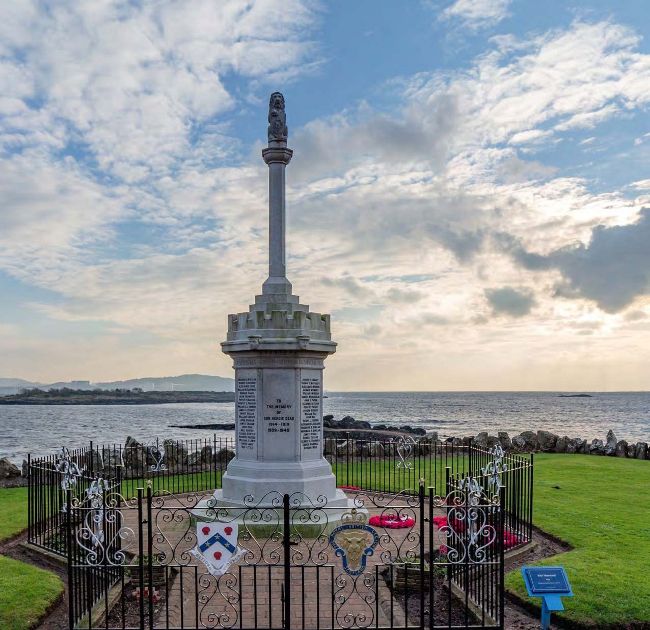
Millport war memorial, commemorating the fallen of the two world wars
Did she cry? Was she consoled? How could she understand – a woman who had never seen an aeroplane – that a bomb dropped from the sky had killed her son? She was remembered as strict, solemn and serious by my mother and her siblings whose family home she shared in the 1930s. ‘Granny Campbell’ had certain expectations: Cuticura soap ordered specially from Glasgow, and a thick veneer of respectability which was hard for her Hebridean grandchildren to understand. She had dark moments too – the children learned to avoid her when she sat brooding, making circles with her thumbs in an anti-clockwise direction (who but children would notice such a habit?). But, what was she thinking?
In quiet moments when talking to family in her west-end flat in Glasgow, my father’s aunt – a spinster, to use the parlance of her youth – would remind us that, regardless of how we found her then, she had received more than one proposal of marriage. A soldier of the Great War, who gifted her a silver pendant, picked up in Russia in 1919, returned more than once from his new homeacross the Atlantic to woo the young schoolteacher. Instead, she remained true to her profession (marriage would have ended her career), and to the care of a succession of nephews (my father included) who boarded with her to save them the long journey to school, over moor and across lochans in North Uist. A strict disciplinarian, in the twenties, she recalled, she had only once ended the school day ahead of the closing bell. When news reached Claddach Kirkibost that a plane was to land on the sand she seized the educational opportunity: ‘You may never see such a machine again’. A hundred years on, we know little, bar fragments, of the fears and expectations of those who survived total war: it is hard to judge just how different lives would have been had war not created a ‘before’ and ‘after’ in their stories. And it pays to be reminded that the inter-war years were not lived as such: after all, was not the whole point that there had been the war to end wars? No-one knew that the blood of millions had bought only 20 years of peace. How much deeper would the grief have been of the young Edinburgh woman, clad in widow’s black, who caught the eye of a Scotsman reporter on 11 November 1918 as she waved a handkerchief at celebrating soldiers, had she known that the hope borne of victory and sacrifice would not even last a generation?
No one knew that in the following 20 years modernity would claim the sea-bed and the skies and even the smallest particle of life itself – the atom - in the service of a new generation of war mongers.
Leggete l'articolo completo e molti altri in questo numero di
History Scotland
Opzioni di acquisto di seguito
Se il problema è vostro,
Accesso
per leggere subito l'articolo completo.
Singolo numero digitale
May - Jun 2019
Questo numero e altri numeri arretrati non sono inclusi in un nuovo
abbonamento. Gli abbonamenti comprendono l'ultimo numero regolare e i nuovi numeri pubblicati durante l'abbonamento.
History Scotland