IN DEPTH Intel’s new Arc series
Intel’s Battlemage
Finally a champion for the budget gamer, Intel’s new Arc series offers memory, speed, quality and machine learning for less, Jarred Walton discovers.
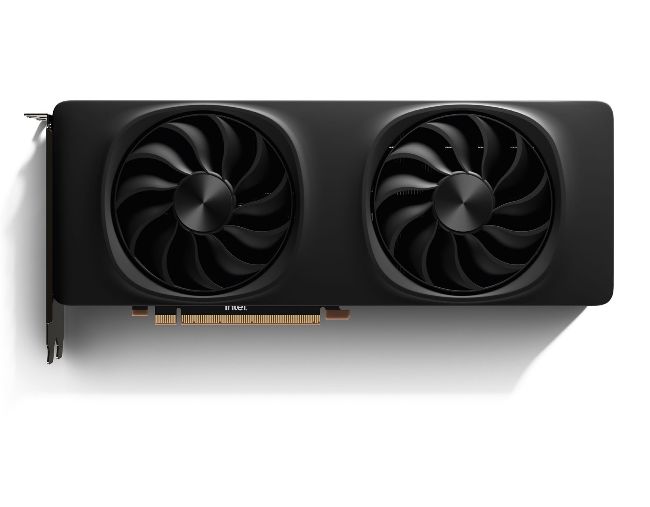
Battling for your PCIe slot, could Intel have won the entry level?
CREDIT: Intel
Intel has launched the Arc B580 and B570 Battlemage GPUs. These are the first two of what we expect will be a full range of discrete GPUs for the Battlemage family, designed for both desktop and mobile markets. The Arc B580 with 12GB of VRAM debuts at £260 (see review, page 19), while the B570 comes equipped with 10GB of VRAM and retails for around £240.
We’ve known the Battlemage name officially for a long time, and know the next two GPU families Intel plans to release in the coming years: Celestial and Druid. But this is the first time Intel has officially spilled the beans on specs, pricing, features and more.
Intel made two important comparisons with the Arc B580 announcement. First is how it stacks up against the Arc A750, and second is how it compares with the Nvidia RTX 4060. The testing was done at 1440p, as Intel says that’s the target resolution for its new GPU. Nvidia said the RTX 4060 targeted 1080p gaming, but we argue that was more about saddling the GPU with only 8GB of VRAM than the raw compute available.
With its own A750, Intel shows a performance uplift of 24% on average across an extensive 47-game test suite. Twenty of the games have XeSS support, which is enabled in the testing, but since it’s Intel versus Intel, that shouldn’t have a major influence on the results.
Against the RTX 4060, Intel shows a 10% performance advantage across the same 47-game test suite, but without XeSS or DLSS upscaling. That’s a fair comparison, as upscaling algorithms differ in how they work and the resulting image quality. There’s a lot more variability with the RTX 4060 comparison as well, with a delta of -17% to +43%. Six of the games show a minor to modest performance loss, while 10 show more than a 20% improvement.