GROWING IN HARMONY
Julie Moore reports on a school in Walton-on-Thames where the principles of sustainability and a healthy approach to food are central to the curriculum
Julie Moore
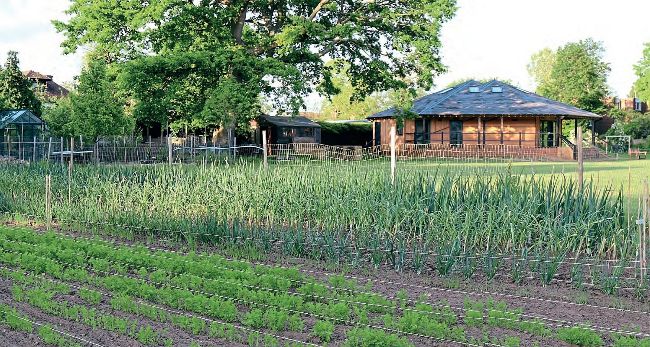
Part of the school field has been converted into growing areas
Since the dawn of time, our ancestors have always understood the need to live in harmony with the natural world, respecting its never-ending cycles and rhythms and sustainable systems. However, since the Industrial Revolution, mankind has become increasingly disconnected and distanced from nature’s systems – there is now little place for harmony in a world dominated by economy. Today, we are living beyond the means of our planet, consuming and polluting in ways that are damaging and degrading to the natural environment.
It’s clear that we need to develop conscious mindsets, collectively implementing better and more sustainable practices in how we live on Earth. What better way to promote sustainability and connectivity than through the education of children?
A REVOLUTION IN LEARNING
Inspired by HRHThe Prince of Wales’ book Harmony which speaks about the philosophy of sustainability and the way nature is all interconnected, headteacher Richard Dunne has incorporated seven key principles of harmony into the school curriculum.
At Ashley C of E Primary School, Waltonon- Thames, a revolution in learning has begun where sustainable living and learning is at the heart of the curriculum. Enquiries of learning linked to a project-based approach, adopting the principles of harmony and using the model of sustainability, a model that has worked for millions of years, have all been introduced into the school curriculum.
“The principles of harmony are about teaching a way of seeing and understanding the world which leads us to a more sustainable way of living”, explains Richard. “Rather than studying individual subjects (Maths, English, Science or Art), a topic like ‘Why are bees so brilliant?’ that Year 2 undertakes would become the subject of an enquiry of learning with all key disciplines explored in reference to the topic. The enquiry approach is really about asking questions and finding things out and allowing children to do that. By using this project-based approach, it’s possible to fulfil the curriculum requirements in an interconnected way that is both engaging and stimulating for the children.” Not surprisingly, the children love to learn this way and Ofsted likes it too.